


Page 168 - Volcanic Textures A Guide To The Interpretation of Textures In Volcanic Rocks
P. 168
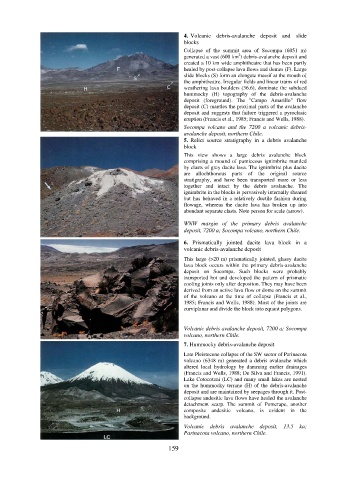
4.  Volcanic debris-avalanche deposit and slide
                                                                  blocks
                                                                  Collapse of the summit area of Socompa  (6051  m)
                                                                                     2
                                                                  generated a vast (600 km ) debris-avalanche deposit and
                                                                  created a 10 km wide amphitheatre that has been partly
                                                                  healed by post-collapse lava flows and domes (F). Large
                                                                  slide blocks (S) form an elongate massif at the mouth of
                                                                  the amphitheatre. Irregular fields and linear trains of red
                                                                  weathering lava boulders (36.6), dominate the subdued
                                                                  hummocky (H) topography  of the debris-avalanche
                                                                  deposit (foreground). The "Campo  Amarillo" flow
                                                                  deposit (C) mantles the proximal parts of the avalanche
                                                                  deposit and suggests that failure triggered a pyroclasic
                                                                  eruption (Francis et al., 1985; Francis and Wells, 1988).

                                                                   Socompa volcano and the 7200 a volcanic debris-
                                                                  avalanche deposit, northern Chile.
                                                                  5.  Relict source  stratigraphy in a debris avalanche
                                                                  block
                                                                  This view shows a large  debris avalanche block
                                                                  comprising a  mound of pumiceous ignimbrite  mantled
                                                                  by clasts of grey dacite lava. The ignimbrite plus dacite
                                                                  are allochthonous parts of the original source
                                                                  stratigraphy, and have been  transported  more or less
                                                                  together and  intact by the debris avalanche. The
                                                                  ignimbrite in the blocks is pervasively internally sheared
                                                                  but has  behaved in a relatively ductile fashion during
                                                                  flowage, whereas the dacite lava has broken up into
                                                                  abundant separate clasts. Note person for scale (arrow).

                                                                  WNW margin of the primary  debris avalanche
                                                                  deposit, 7200 a; Socompa volcano, northern Chile.

                                                                  6.  Prismatically jointed dacite lava block in a
                                                                  volcanic debris-avalanche deposit
                                                                  This large (>20  m) prismatically jointed, glassy dacite
                                                                  lava block occurs within the  primary debris-avalanche
                                                                  deposit  on Socompa. Such blocks  were probably
                                                                  transported hot and developed the pattern of prismatic
                                                                  cooling joints only after depositon. They may have been
                                                                  derived from an active lava flow or dome on the summit
                                                                  of the volcano at the time of collapse (Francis et al.,
                                                                  1985; Francis and Wells, 1988). Most of the joints are
                                                                  curviplanar and divide the block into equant polygons.

                                                                  Volcanic debris avalanche deposit, 7200 a; Socompa
                                                                   volcano, northern Chile.
                                                                  7. Hummocky debris-avalanche deposit
                                                                  Late Pleistocene collapse of the SW sector of Parinacota
                                                                  volcano (6348  m) generated  a debris  avalanche which
                                                                  altered local  hydrology by damming earlier drainages
                                                                  (Francis and Wells, 1988; De Silva and Francis, 1991).
                                                                  Lake Cotocotani (LC) and many small lakes are nested
                                                                  on the hummocky terrane (H) of the debris-avalanche
                                                                  deposit and are maintained by seepages through it. Post-
                                                                  collapse andesitic lava flows have healed the avalanche
                                                                  detachment scarp. The summit of Pomerape, another
                                                                  composite andesitic volcano, is evident in the
                                                                  background.
                                                                  Volcanic  debris avalanche deposit,  13.5 ka;
                                                                  Parinacota volcano, northern Chile.

                                                            159

