


Page 170 - Volcanic Textures A Guide To The Interpretation of Textures In Volcanic Rocks
P. 170
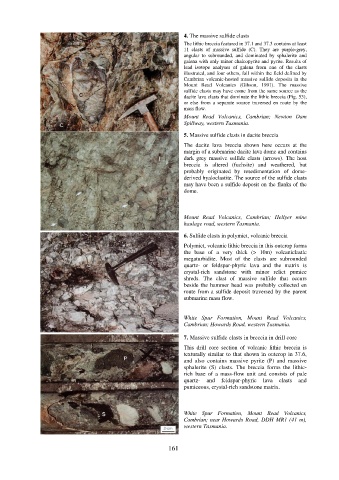
4. The massive sulfide clasts
                                                                  The lithic breccia featured in 37.1 and 37.3 contains at least
                                                                  11 clasts of massive sulfide (C). They are purple-grey,
                                                                  angular to subrounded, and dominated by sphalerite and
                                                                  galena with only minor chalcopyrite and pyrite. Results of
                                                                  lead  isotope analyses of galena from one of the clasts
                                                                  illustrated, and four others, fall within the field defined by
                                                                  Cambrian volcanic-hosted massive sulfide deposits in the
                                                                  Mount Read Volcanics (Gibson, 1991). The massive
                                                                  sulfide clasts may have come from the same source as the
                                                                  dacite lava clasts that dominate the lithic breccia (Fig. 53),
                                                                  or else from a  separate source  traversed en route by the
                                                                  mass flow.
                                                                  Mount Read  Volcanics, Cambrian; Newton Dam
                                                                  Spillway, western Tasmania.

                                                                  5. Massive sulfide clasts in dacite breccia
                                                                  The dacite lava breccia shown here occurs at the
                                                                  margin of a submarine dacite lava dome and contains
                                                                  dark grey massive sulfide  clasts (arrows). The host
                                                                  breccia is altered  (fuchsite) and  weathered, but
                                                                  probably originated  by resedimentation of dome-
                                                                  derived hyaloclastite. The source of the sulfide clasts
                                                                  may have been a sulfide deposit on the flanks of the
                                                                  dome.


                                                                  Mount  Read Volcanics,  Cambrian; Hellyer  mine
                                                                  haulage road, western Tasmania.

                                                                  6. Sulfide clasts in polymict, volcanic breccia
                                                                  Polymict, volcanic lithic breccia in this outcrop forms
                                                                  the base of a very thick (> 10m) volcaniclastic
                                                                  megaturbidite. Most  of the clasts are subrounded
                                                                  quartz- or  feldspar-phyric lava and the  matrix is
                                                                  crystal-rich sandstone with  minor relict pumice
                                                                  shreds. The  clast of massive sulfide that occurs
                                                                  beside the  hammer head  was  probably collected en
                                                                  route from a sulfide deposit traversed by the parent
                                                                  submarine mass flow.


                                                                  White Spur  Formation,  Mount Read Volcanics,
                                                                  Cambrian; Howards Road, western Tasmania.

                                                                  7. Massive sulfide clasts in breccia in drill core

                                                                  This drill core section  of  volcanic lithic breccia is
                                                                  texturally similar to that shown in outcrop in 37.6,
                                                                  and  also  contains  massive pyrite (P) and  massive
                                                                  sphalerite (S)  clasts. The breccia  forms the lithic-
                                                                  rich  base  of a mass-flow  unit and consists of  pale
                                                                  quartz- and  feldspar-phyric lava clasts and
                                                                  pumiceous, crystal-rich sandstone matrix.


                                                                  White  Spur  Formation, Mount Read Volcanics,
                                                                  Cambrian; near Howards Road, DDH MR1 (41 m),
                                                                  western Tasmania.


                                                            161

