


Page 174 - Volcanic Textures A Guide To The Interpretation of Textures In Volcanic Rocks
P. 174
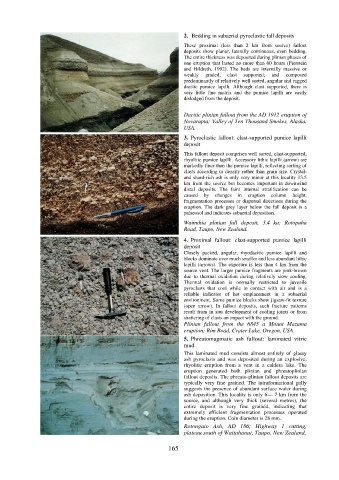
2.  Bedding in subaerial pyroclastic fall deposits
                                                                  These proximal (less than 2  km from source) fallout
                                                                  deposits show planar, laterally  continuous, even bedding.
                                                                  The entire thickness was deposited during plinian phases of
                                                                  one eruption that lasted no more than 60 hours (Fierstein
                                                                  and Hildreth, 1992). The beds are internally  massive or
                                                                  weakly  graded,  clast  supported,  and  composed
                                                                  predominantly of relatively well sorted, angular and ragged
                                                                  dacitic pumice  lapilli. Although clast supported, there is
                                                                  very  little fine  matrix and the pumice lapilli are easily
                                                                  dislodged from the deposit.

                                                                  Dacitic plinian fallout from the AD 1912 eruption of
                                                                  Novarupta; Valley of Ten Thousand Smokes, Alaska,
                                                                   USA.
                                                                  3.  Pyroclastic fallout: clast-supported  pumice lapilli
                                                                  deposit
                                                                  This fallout deposit comprises well sorted, clast-supported,
                                                                  rhyolitic pumice lapilli. Accessory lithic lapilli (arrow) are
                                                                  markedly finer than the pumice lapilli, reflecting sorting of
                                                                  clasts according to density rather than grain size. Crystal-
                                                                  and shard-rich ash is only very minor at this locality 13.5
                                                                  km from the source but becomes important in  downwind
                                                                  distal deposits. The faint internal stratification can be
                                                                  caused by changes in eruption column height,
                                                                  fragmentation processes or dispersal directions during the
                                                                  eruption. The dark grey layer  below the fall deposit is a
                                                                  palaeosol and indicates subaerial deposition.
                                                                  Waimihia  plinian fall deposit, 3.4 ka;  Rotopuha
                                                                  Road, Taupo, New Zealand.

                                                                  4.  Proximal fallout: clast-supported pumice lapilli
                                                                  deposit
                                                                  Closely packed, angular, rhyodacitic pumice lapilli and
                                                                  blocks dominate over much smaller and less abundant lithic
                                                                  lapilli (arrows). The exposure is less than 4 km from the
                                                                  source vent. The larger pumice fragments are pink-brown
                                                                  due to thermal  oxidation during relatively slow cooling.
                                                                  Thermal oxidation is normally restricted to juvenile
                                                                  pyroclasts that cool while in  contact with air and is a
                                                                  reliable indicator of hot emplacement in a subaerial
                                                                  environment. Some pumice blocks show jigsaw-fit texture
                                                                  (open arrow). In fallout deposits, such fracture patterns
                                                                  result from in situ development of cooling joints or from
                                                                  shattering of clasts on impact with the ground.
                                                                  Plinian fallout from  the 6845  a Mount Mazama
                                                                  eruption; Rim Road, Crater Lake, Oregon, USA.
                                                                  5.  Phreatomagmatic ash fallout: laminated vitric
                                                                  mud
                                                                  This laminated mud consists almost entirely of glassy
                                                                  ash pyroclasts  and was deposited during an explosive,
                                                                  rhyolitic eruption from a vent in a caldera lake. The
                                                                  eruption  generated both plinian and phreatoplinian
                                                                  fallout deposits. The phreato-plinian fallout deposits are
                                                                  typically very fine grained. The intraformational gully
                                                                  suggests the presence of abundant surface water during
                                                                  ash deposition. This locality is only 6— 7 km from the
                                                                  source, and although very thick (several metres), the
                                                                  entire deposit is very fine grained, indicating that
                                                                  extremely efficient fragmentation processes operated
                                                                  during the eruption. Coin diameter is 28 mm.
                                                                  Rotongaio  Ash, AD 186; Highway  1 cutting,
                                                                  plateau south of Waitahanui, Taupo, New Zealand.

                                                            165

