


Page 175 - Volcanic Textures A Guide To The Interpretation of Textures In Volcanic Rocks
P. 175
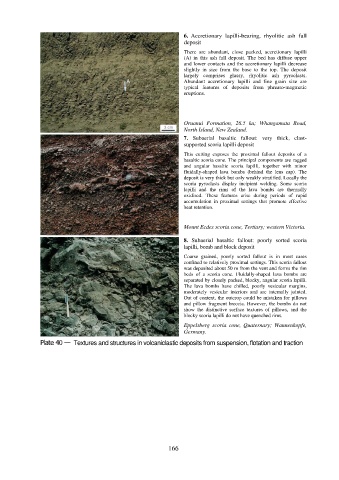
6.  Accretionary lapilli-bearing, rhyolitic ash fall
                                                                  deposit

                                                                  There are abundant, close packed, accretionary lapilli
                                                                  (A) in this ash fall deposit. The bed has diffuse upper
                                                                  and lower contacts and the accretionary lapilli decrease
                                                                  slightly in size from the base to the top. The deposit
                                                                  largely comprises glassy, rhyolitic ash pyroclasts.
                                                                  Abundant accretionary lapilli and fine grain size are
                                                                  typical features of deposits from phreato-magmatic
                                                                  eruptions.


                                                                  Oruanui Formation,  26.5 ka; Whangamata  Road,
                                                                   North Island, New Zealand.
                                                                  7.  Subaerial basaltic fallout: very thick, clast-
                                                                  supported scoria lapilli deposit
                                                                  This cutting  exposes the proximal fallout deposits of a
                                                                  basaltic scoria cone. The principal components are ragged
                                                                  and angular basaltic scoria  lapilli, together  with minor
                                                                  fluidally-shaped lava bombs  (behind the lens  cap). The
                                                                  deposit is very thick but only weakly stratified. Locally the
                                                                  scoria pyroclasts display  incipient welding. Some scoria
                                                                  lapilli  and the rims of the lava bombs are thermally
                                                                  oxidised. These features arise during periods of rapid
                                                                  accumulation in proximal settings that promote effective
                                                                  heat retention.

                                                                  Mount Ecdes scoria cone, Tertiary; western Victoria.

                                                                  8.  Subaerial basaltic fallout: poorly sorted scoria
                                                                  lapilli, bomb and block deposit

                                                                  Coarse grained, poorly sorted fallout  is in  most cases
                                                                  confined to relatively proximal settings. This scoria fallout
                                                                  was deposited about 50 m from the vent and forms the rim
                                                                  beds of a scoria cone. Fluidally-shaped lava bombs are
                                                                  separated by closely packed, blocky, angular scoria lapilli.
                                                                  The  lava bombs have  chilled,  poorly vesicular margins,
                                                                  moderately vesicular interiors and are internally jointed.
                                                                  Out of context, the outcrop could be mistaken for pillows
                                                                  and pillow fragment breccia. However, the bombs do not
                                                                  show the distinctive surface  textures of pillows, and the
                                                                  blocky scoria lapilli do not have quenched rims.
                                                                  Eppelsberg scoria cone, Quaternary; Wannenkopfe,
                                                                   Germany.
               Plate 40 —  Textures and structures in volcaniclastic deposits from suspension, flotation and traction


                                                            166

