


Page 171 - Volcanic Textures A Guide To The Interpretation of Textures In Volcanic Rocks
P. 171
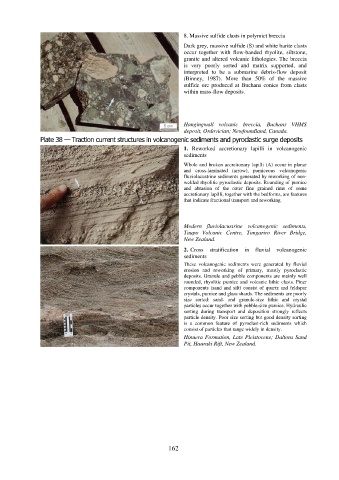
8. Massive sulfide clasts in polymict breccia
                                                                  Dark grey, massive sulfide (S) and white barite clasts
                                                                  occur together with flow-banded  rhyolite, siltstone,
                                                                  granite and altered volcanic lithologies. The breccia
                                                                  is very poorly sorted and  matrix supported, and
                                                                  interpreted to be a submarine debris-flow  deposit
                                                                  (Binney,  1987). More than 50%  of the massive
                                                                  sulfide ore  produced at Buchans conies from clasts
                                                                  within mass-flow deposits.


                                                                  Hangingwall  volcanic breccia, Buchans VHMS
                                                                  deposit, Ordovician; Newfoundland, Canada.
               Plate 38 — Traction current structures in volcanogenic sediments and pyroclastic surge deposits
                                                                  1.  Reworked accretionary lapilli in volcanogenic
                                                                  sediments

                                                                  Whole and broken accretionary lapilli (A) occur in planar
                                                                  and cross-laminated (arrow), pumiceous volcanogenic
                                                                  fluviolacustrine sediments generated by reworking of non-
                                                                  welded rhyolitic pyroclastic deposits. Rounding of pumice
                                                                  and abrasion of the outer fine grained rims of some
                                                                  accretionary lapilli, together with the bedforms, are features
                                                                  that indicate fractional transport and reworking.


                                                                  Modern fluviolacustrine volcanogenic  sediments,
                                                                  Taupo Volcanic Centre, Tongariro River Bridge,
                                                                   New Zealand.
                                                                  2.  Cross stratification in  fluvial volcanogenic
                                                                  sediments
                                                                  These volcanogenic sediments  were generated  by fluvial
                                                                  erosion and reworking of primary, mostly  pyroclastic
                                                                  deposits. Granule and pebble components are mainly well
                                                                  rounded, rhyolitic pumice and volcanic lithic clasts. Finer
                                                                  components (sand and silt) consist of quartz and feldspar
                                                                  crystals, pumice and glass shards. The sediments are poorly
                                                                  size sorted: sand- and granule-size lithic  and crystal
                                                                  particles occur together with pebble-size pumice. Hydraulic
                                                                  sorting during transport and deposition strongly reflects
                                                                  particle density. Poor size sorting but good density sorting
                                                                  is a common feature of pyroclast-rich sediments which
                                                                  consist of particles that range widely in density.
                                                                  Hinuera Formation, Late Pleistocene; Daltons Sand
                                                                   Pit, Hauraki Rift, New Zealand.


                                                            162

