


Page 172 - Volcanic Textures A Guide To The Interpretation of Textures In Volcanic Rocks
P. 172
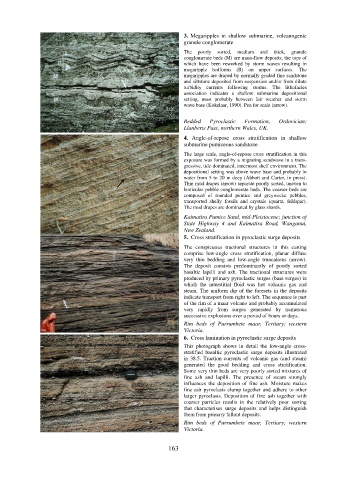
3.  Megaripples in shallow submarine, volcanogenic
                                                                  granule conglomerate

                                                                  The poorly  sorted, medium and thick, granule
                                                                  conglomerate beds (M) are mass-flow deposits, the tops of
                                                                  which have been reworked  by storm waves resulting in
                                                                  megaripple bedforms (R) on upper surfaces. The
                                                                  megaripples are draped by normally graded fine sandstone
                                                                  and siltstone deposited from suspension and/or from dilute
                                                                  turbidity  currents following storms. The lithofacies
                                                                  association indicates a shallow submarine depositional
                                                                  setting, most probably between fair weather and storm
                                                                  wave base (Kokelaar, 1990). Pen for scale (arrow).

                                                                  Bedded   Pyroclastic  Formation,  Ordovician;
                                                                   Llanberis Pass, northern Wales, UK.
                                                                  4.  Angle-of-repose cross stratification in shallow
                                                                  submarine pumiceous sandstone
                                                                  The large scale, angle-of-repose cross stratification in this
                                                                  exposure was formed by a migrating sandwave in a trans-
                                                                  gressive, tide-dominated, innermost shelf environment. The
                                                                  depositional setting was above wave base and probably in
                                                                  water from 5 to 20 m deep (Abbott and Carter, in press).
                                                                  Thin mud drapes (arrow) separate poorly sorted, uneven to
                                                                  lenticular pebble conglomerate beds. The coarser beds are
                                                                  composed of rounded pumice and greywacke pebbles,
                                                                  transported shelly fossils and crystals (quartz, feldspar).
                                                                  The mud drapes are dominated by glass shards.
                                                                  Kaimatira Pumice Sand, mid-Pleistocene; junction of
                                                                  State  Highway 4  and Kaimatira Road,  Wanganui,
                                                                  New Zealand.
                                                                  5.  Cross stratification in pyroclastic surge deposits

                                                                  The conspicuous tractional structures in this cutting
                                                                  comprise low-angle cross  stratification, planar diffuse
                                                                  very thin bedding and low-angle truncations (arrow).
                                                                  The deposit consists predominantly of poorly sorted
                                                                  basaltic lapilli  and ash. The tractional structures were
                                                                  produced by primary pyroclastic surges (base surges) in
                                                                  which the interstitial fluid was hot  volcanic gas and
                                                                  steam. The uniform dip of the foresets in the deposits
                                                                  indicate transport from right to left. The sequence is part
                                                                  of the rim of a maar volcano and probably accumulated
                                                                  very rapidly  from surges  generated by numerous
                                                                  successive explosions over a period of hours or days.
                                                                  Rim beds  of  Purrumbete  maar, Tertiary; western
                                                                  Victoria.
                                                                  6.  Cross lamination in pyroclastic surge deposits
                                                                  This photograph shows in detail the low-angle cross-
                                                                  stratified basaltic pyroclastic surge deposits illustrated
                                                                  in 38.5. Traction currents of volcanic gas (and steam)
                                                                  generated the  good bedding  and cross stratification.
                                                                  Some very thin beds are very poorly sorted mixtures of
                                                                  fine ash and lapilli. The presence of steam strongly
                                                                  influences the  deposition of fine ash.  Moisture  makes
                                                                  fine ash pyroclasts clump together and adhere to other
                                                                  larger pyroclasts. Deposition of fine ash together with
                                                                  coarser particles results in the relatively poor sorting
                                                                  that characterises  surge deposits and helps distinguish
                                                                  them from primary fallout deposits.
                                                                  Rim beds  of  Purrumbete  maar, Tertiary; western
                                                                   Victoria.


                                                            163

