


Page 177 - Volcanic Textures A Guide To The Interpretation of Textures In Volcanic Rocks
P. 177
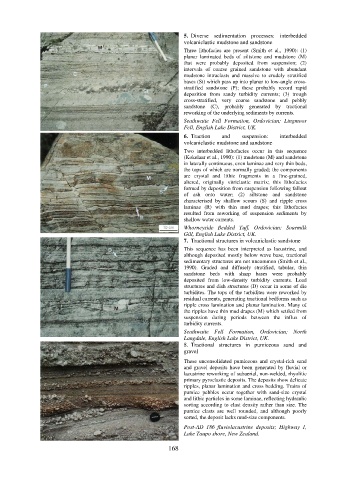
5. Diverse  sedimentation  processes: interbedded
                                                                  volcaniclastic mudstone and sandstone
                                                                  Three  lithofacies are  present (Smith et  al., 1990):  (1)
                                                                  planar laminated beds of  siltstone and  mudstone (M)
                                                                  that were  probably deposited from  suspension; (2)
                                                                  intervals of coarse grained sandstone with abundant
                                                                  mudstone intraclasts and  massive to crudely stratified
                                                                  bases (St) which pass up into planar to low-angle cross-
                                                                  stratified sandstone (P); these probably record rapid
                                                                  deposition from  sandy turbidity currents;  (3) trough
                                                                  cross-stratified, very coarse sandstone  and pebbly
                                                                  sandstone (C), probably generated by  tractional
                                                                  reworking of the underlying sediments by currents.
                                                                  Seathwaite Fell Formation, Ordovician;  Lingmoor
                                                                   Fell, English Lake District, UK.
                                                                  6.  Traction  and   suspension:  interbedded
                                                                  volcaniclastic mudstone and sandstone
                                                                  Two interbedded lithofacies  occur in this  sequence
                                                                  (Kokelaar et al., 1990): (1) mudstone (M) and sandstone
                                                                  in laterally continuous, even laminae and very thin beds,
                                                                  the tops of which are normally graded; the components
                                                                  are crystal and lithic fragments in a fine-grained,
                                                                  altered, originally vitriclastic  matrix; this  lithofacies
                                                                  formed by deposition from suspension following fallout
                                                                  of ash  onto water; (2)  siltstone and sandstone
                                                                  characterised by shallow scours (S) and ripple cross
                                                                  laminae (R)  with thin  mud drapes; this  lithofacies
                                                                  resulted from  reworking of suspension  sediments by
                                                                  shallow water currents.
                                                                  Whorneyside Bedded  Tuff, Ordovician; Sourmilk

                                                                  Gill, English Lake District, UK.
                                                                  7.  Tractional structures in volcaniclastic sandstone
                                                                  This sequence  has been interpreted as lacustrine, and
                                                                  although deposited mostly below wave base, tractional
                                                                  sedimentary structures are not uncommon (Smith et al.,
                                                                  1990). Graded and diffusely stratified, tabular, thin
                                                                  sandstone beds with  sharp bases were probably
                                                                  deposited from low-density turbidity currents. Load
                                                                  structures and dish structures (D) occur in some of die
                                                                  turbidites. The tops of the turbidites were reworked by
                                                                  residual currents, generating tractional bedforms such as
                                                                  ripple cross lamination and planar lamination. Many of
                                                                  the ripples have thin mud drapes (M) which settled from
                                                                  suspension during periods between the  influx of
                                                                  turbidity currents.
                                                                   Seathwaite Fell Formation, Ordovician; North
                                                                  Langdale, English Lake District, UK.
                                                                  8. Tractional  structures in pumiceous sand and
                                                                  gravel
                                                                  These unconsolidated pumiceous and crystal-rich sand
                                                                  and gravel deposits have been generated by fluvial or
                                                                  lacustrine reworking of subaerial, non-welded, rhyolitic
                                                                  primary pyroclastic deposits. The deposits show delicate
                                                                  ripples, planar lamination and cross bedding. Trains of
                                                                  pumice  pebbles occur together with  sand-size crystal
                                                                  and lithic particles in some laminae, reflecting hydraulic
                                                                  sorting according to clast density rather than size. The
                                                                  pumice clasts  are well rounded, and although poorly
                                                                  sorted, the deposit lacks mud-size components.
                                                                  Post-AD 186  fluviolacustrine deposits; Highway 1,
                                                                  Lake Taupo shore, New Zealand.

                                                            168

