


Page 173 - Volcanic Textures A Guide To The Interpretation of Textures In Volcanic Rocks
P. 173
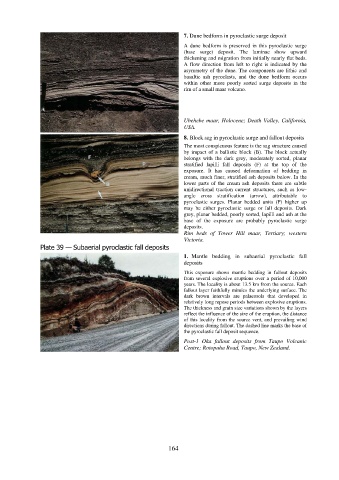
7. Dune bedform in pyroclastic surge deposit
                                                                  A dune bedform is preserved in this pyroclastic surge
                                                                  (base surge) deposit.  The laminae show  upward
                                                                  thickening and migration from initially nearly flat beds.
                                                                  A flow direction from left to  right is indicated by the
                                                                  asymmetry of the dune. The components are lithic and
                                                                  basaltic ash pyroclasts, and the dune bedform occurs
                                                                  within other  more poorly sorted surge deposits in the
                                                                  rim of a small maar volcano.


                                                                  Ubehebe maar, Holocene; Death Valley, California,
                                                                  USA.

                                                                  8. Block sag in pyroclastic surge and fallout deposits
                                                                  The most conspicuous feature is the sag structure caused
                                                                  by impact of a ballistic block (B). The block actually
                                                                  belongs with the dark grey, moderately sorted, planar
                                                                  stratified lapilli fall deposits (F) at the top of the
                                                                  exposure. It has caused deformation of bedding in
                                                                  cream, much finer, stratified ash deposits below. In the
                                                                  lower parts of  the cream  ash  deposits there  are subtle
                                                                  unidirectional traction current structures, such as low-
                                                                  angle cross stratification (arrow), attributable to
                                                                  pyroclastic surges. Planar bedded units (P) higher up
                                                                  may be either pyroclastic surge or fall deposits. Dark
                                                                  grey, planar bedded, poorly sorted, lapilli and ash at the
                                                                  base of the exposure are  probably pyroclastic surge
                                                                  deposits.
                                                                   Rim  beds of Tower Hill  maar, Tertiary; western
                                                                  Victoria.
               Plate 39 — Subaerial pyroclastic fall deposits
                                                                  1.  Mantle bedding in subaerial pyroclastic fall
                                                                  deposits
                                                                  This exposure shows  mantle  bedding in fallout deposits
                                                                  from several explosive eruptions over a period  of 10,000
                                                                  years. The locality is about 13.5 km from the source. Each
                                                                  fallout layer faithfully mimics the underlying surface. The
                                                                  dark brown intervals  are palaeosols that developed in
                                                                  relatively long repose periods between explosive eruptions.
                                                                  The thickness and grain size variations shown by the layers
                                                                  reflect the influence of the size of the eruption, the distance
                                                                  of this locality from the source vent, and prevailing wind
                                                                  directions during fallout. The dashed line marks the base of
                                                                  the pyroclastic fall deposit sequence.
                                                                  Post-1  Oka fallout deposits from Taupo Volcanic
                                                                   Centre; Rotopuha Road, Taupo, New Zealand.


                                                            164

