


Page 176 - Volcanic Textures A Guide To The Interpretation of Textures In Volcanic Rocks
P. 176
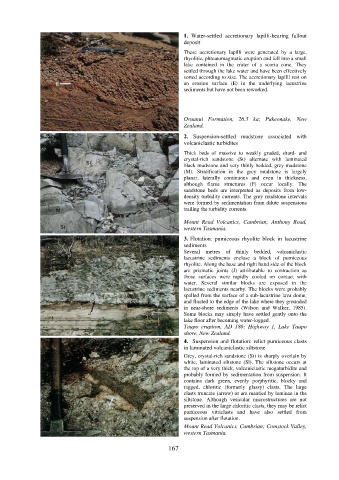
1.  Water-settled accretionary lapilli-bearing fallout
                                                                  deposit

                                                                  These accretionary lapilli were generated by a large,
                                                                  rhyolitic, phreatomagmatic eruption and fell into a small
                                                                  lake contained in the crater of a  scoria  cone. They
                                                                  settled through the lake water and have been effectively
                                                                  sorted according to size. The accretionary lapilli rest on
                                                                  an erosion  surface (E) in the underlying lacustrine
                                                                  sediments but have not been reworked.


                                                                  Oruanui Formation,  26.5 ka; Pukeonake, New
                                                                  Zealand.

                                                                  2.  Suspension-settled mudstone associated with
                                                                  volcaniclastic turbidites
                                                                  Thick beds of  massive to weakly graded, shard- and
                                                                  crystal-rich sandstone (St)  alternate  with laminated
                                                                  black mudstone and very thinly bedded, grey mudstone
                                                                  (M). Stratification in the grey  mudstone is largely
                                                                  planar, laterally continuous  and even in  thickness,
                                                                  although flame structures (F) occur locally. The
                                                                  sandstone beds are interpreted as deposits from low-
                                                                  density turbidity currents. The grey mudstone intervals
                                                                  were formed by sedimentation from dilute suspensions
                                                                  trailing the turbidity currents.

                                                                  Mount Read  Volcanics, Cambrian;  Anthony Road,
                                                                   western Tasmania.
                                                                  3. Flotation:  pumiceous  rhyolite block in lacustrine
                                                                  sediments
                                                                  Several  metres of thinly bedded, volcaniclastic
                                                                  lacustrine sediments  enclose a block of  pumiceous
                                                                  rhyolite. Along the base and right hand side of the block
                                                                  are prismatic joints (J) attributable to contraction  as
                                                                  those  surfaces were rapidly cooled on contact with
                                                                  water. Several similar blocks are exposed in the
                                                                  lacustrine sediments nearby. The blocks were probably
                                                                  spalled from the surface of a sub-lacustrine lava dome,
                                                                  and floated to the edge of the lake where they grounded
                                                                  in near-shore  sediments (Wilson and Walker, 1985).
                                                                  Some blocks  may simply have settled gently onto the
                                                                  lake floor after becoming water-logged.
                                                                  Taupo eruption, AD  186;  Highway  1, Lake Taupo
                                                                  shore, New Zealand.
                                                                  4.  Suspension and flotation: relict pumiceous clasts
                                                                  in laminated volcaniclastic siltstone
                                                                  Grey, crystal-rich sandstone (St) is sharply overlain by
                                                                  white, laminated siltstone (Sl). The siltstone  occurs at
                                                                  the top of a very thick, volcaniclastic megaturbidite and
                                                                  probably formed by sedimentation from suspension. It
                                                                  contains dark  green, evenly porphyritic, blocky and
                                                                  ragged, chloritic (formerly glassy) clasts.  The large
                                                                  clasts truncate (arrow) or are mantled by laminae in the
                                                                  siltstone.  Although vesicular  microstructures are not
                                                                  preserved in the large chloritic clasts, they may be relict
                                                                  pumiceous vitriclasts and have also  settled from
                                                                  suspension after flotation.
                                                                  Mount Read Volcanics, Cambrian; Comstock Valley,
                                                                  western Tasmania.

                                                            167

