


Page 167 - Volcanic Textures A Guide To The Interpretation of Textures In Volcanic Rocks
P. 167
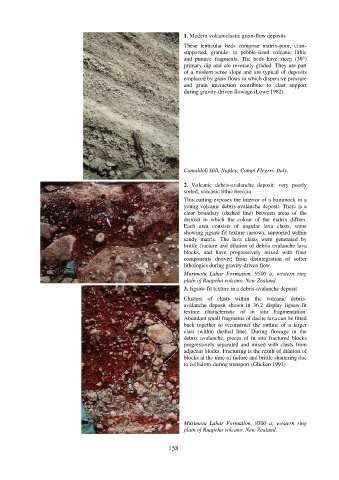
1. Modern volcaniclastic grain-flow deposits
                                                                  These lenticular  beds comprise matrix-poor, clast-
                                                                  supported, granule- to pebble-sized volcanic lithic
                                                                  and  pumice fragments. The beds  have steep (30°)
                                                                  primary dip and are reversely graded. They are part
                                                                  of a modern scree slope and are typical of deposits
                                                                  emplaced by grain flows in which dispersive pressure
                                                                  and grain interaction contribute to clast support
                                                                  during gravity-driven flowage (Lowe 1982).


                                                                  Camaldoli Hill, Naples; Campi Flegrei, Italy.

                                                                  2.  Volcanic debris-avalanche deposit: very poorly
                                                                  sorted, volcanic lithic breccia
                                                                  This cutting exposes the interior of a hummock in a
                                                                  young volcanic debris-avalanche deposit. There is a
                                                                  clear boundary (dashed line)  between areas of the
                                                                  deposit in which the colour of the matrix  differs.
                                                                  Each area consists of angular lava clasts, some
                                                                  showing jigsaw-fit texture (arrow), supported within
                                                                  sandy matrix. The lava clasts were generated  by
                                                                  brittle fracture and dilation of debris avalanche lava
                                                                  blocks, and  have progressively  mixed with finer
                                                                  components derived from  disintegration of softer
                                                                  lithologies during gravity-driven flow.
                                                                  Murimotu  Lahar Formation, 9500 a; western ring
                                                                   plain of Ruapehu volcano, New Zealand.
                                                                  3. Jigsaw-fit texture in a debris-avalanche deposit

                                                                  Clusters of  clasts within the volcanic debris-
                                                                  avalanche deposit shown in 36.2 display jigsaw-fit
                                                                  texture characteristic of  in situ fragmentation.
                                                                  Abundant small fragments of dacite lava can be fitted
                                                                  back  together to  reconstruct the outline of  a  larger
                                                                  clast (within  dashed line).  During  flowage in the
                                                                  debris avalanche,  pieces of in situ fractured blocks
                                                                  progressively separated and  mixed with clasts from
                                                                  adjacent blocks. Fracturing is the result of dilation of
                                                                  blocks at the time of failure and brittle shattering due
                                                                  to collisions during transport (Glicken 1991).


                                                                  Murimotu  Lahar Formation, 9500 a; western ring
                                                                   plain of Ruapehu volcano, New Zealand.

                                                            158

