


Page 162 - Volcanic Textures A Guide To The Interpretation of Textures In Volcanic Rocks
P. 162
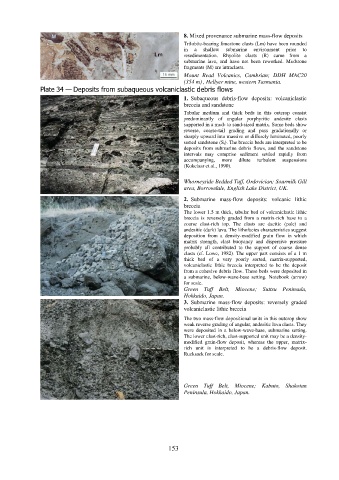
8. Mixed provenance submarine mass-flow deposits
                                                                  Trilobite-bearing limestone clasts (Lm) have been rounded
                                                                  in  a  shallow  submarine  environment  prior  to
                                                                  resedimentation. Rhyolite clasts (R) came from a
                                                                  submarine lava, and have not  been reworked. Mudstone
                                                                  fragments (M) are intraclasts.
                                                                   Mount Read Volcanics, Cambrian; DDH MAC20
                                                                  (354 m) , Hellyer mine, western Tasmania.
               Plate 34 — Deposits from subaqueous volcaniclastic debris flows
                                                                  1.  Subaqueous  debris-flow deposits: volcaniclastic
                                                                  breccia and sandstone
                                                                  Tabular medium and thick beds in this outcrop consist
                                                                  predominantly  of angular porphyritic andesite  clasts
                                                                  supported in a mud- to sand-sized matrix. Some beds show
                                                                  reverse, coarse-tail grading and pass gradationally or
                                                                  sharply upward into massive or diffusely laminated, poorly
                                                                  sorted sandstone (S t ). The breccia beds are interpreted to be
                                                                  deposits from submarine debris flows, and the sandstone
                                                                  intervals may comprise sediment settled rapidly from
                                                                  accompanying,  more  dilute  turbulent  suspensions
                                                                  (Kokelaar et al., 1990).

                                                                  Whorneyside Bedded Tuff, Ordovician; Sourmilk Gill
                                                                  area, Borrowdale, English Lake District, UK.

                                                                  2.  Submarine mass-flow deposits: volcanic lithic
                                                                  breccia
                                                                  The lower 1.5 m thick, tabular bed of volcaniclastic lithic
                                                                  breccia is reversely graded from a matrix-rich base to  a
                                                                  coarse  clast-rich top. The clasts are dacitic  (pale) and
                                                                  andesitic (dark) lava. The lithofacies characteristics suggest
                                                                  deposition from a density-modified grain flow in which
                                                                  matrix strength, clast buoyancy and dispersive pressure
                                                                  probably  all contributed to  the support of  coarse dense
                                                                  clasts (cf. Lowe, 1982). The upper part consists of a 1 m
                                                                  thick bed of  a very poorly sorted, matrix-supported,
                                                                  volcaniclastic  lithic breccia interpreted  to be the deposit
                                                                  from a cohesive debris flow. These beds were deposited in
                                                                  a submarine, below-wave-base  setting. Notebook (arrow)
                                                                  for scale.
                                                                  Green Tuff Belt, Miocene;  Suttsu Peninsula,
                                                                   Hokkaido, Japan.
                                                                  3.  Submarine  mass-flow  deposits: reversely graded
                                                                  volcaniclastic lithic breccia
                                                                  The two mass-flow depositional units in this outcrop show
                                                                  weak reverse grading of angular, andesitic lava clasts. They
                                                                  were deposited  in a below-wave-base, submarine setting.
                                                                  The lower clast-rich, clast-supported unit may be a density-
                                                                  modified grain-flow deposit, whereas  the upper, matrix-
                                                                  rich unit is interpreted to be a debris-flow deposit.
                                                                  Rucksack for scale.


                                                                  Green Tuff  Belt, Miocene; Kabuto,  Shakotan
                                                                  Peninsula, Hokkaido, Japan.


                                                            153

