


Page 109 - Volcanic Textures A Guide To The Interpretation of Textures In Volcanic Rocks
P. 109
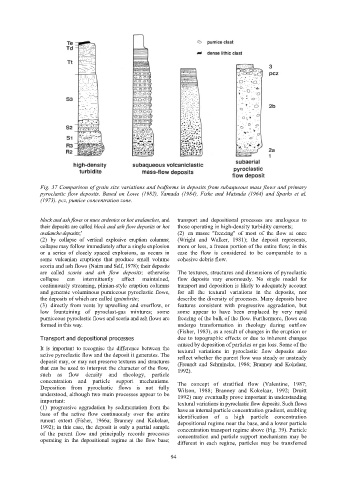
Fig. 37 Comparison of grain size variations and bedforms in deposits from subaqueous mass flows and primary
               pyroclastic flow deposits. Based on Lowe (1982), Yamada (1984), Fiske and Matsuda (1964) and  Sparks et al.
               (1973). pcz, pumice concentration zone.


               block and ash flows or nuee ardentes or hot avalanches, and   transport and depositional processes are  analogous  to
               their deposits are called block and ash flow deposits or hot   those operating in high-density turbidity currents;
               avalanche deposits;'                            (2)  en masse "freezing" of most of the flow  at once
               (2)  by collapse of vertical explosive eruption columns;   (Wright  and Walker, 1981);  the deposit  represents,
               collapse may follow immediately after a single explosion   more or less, a frozen portion of the entire flow; in this
               or  a  series  of closely spaced explosions,  as occurs in   case the flow is considered  to  be  comparable  to  a
               some  vulcanian  eruptions that produce small volume   cohesive debris flow.
               scoria and ash flows (Nairn and Self, 1978); their deposits
               are called  scoria  and ash flow  deposits;  otherwise   The textures, structures and dimensions of pyroclastic
               collapse  can  intermittently  affect  maintained,  flow deposits  vary enormously. No single  model for
               continuously streaming, plinian-style eruption columns   transport and deposition is likely to adequately account
               and generate voluminous pumiceous pyroclastic flows,   for all  the  textural variations in the deposits, nor
               the deposits of which are called ignimbrite;    describe the diversity of processes. Many deposits have
               (3)  directly from vents by upwelling and overflow, or   features consistent with progressive  aggradation, but
               low  fountaining of pyroclast-gas  mixtures;  some   some  appear to have been  emplaced by very rapid
               pumiceous pyroclastic flows and scoria and ash flows are   freezing of the bulk of the flow. Furthermore, flows can
               formed in this way.                             undergo transformation in  rheology  during outflow
                                                               (Fisher, 1983), as a result of changes in the eruption or
               Transport and depositional processes            due to topographic effects or due to inherent changes
                                                               caused by deposition of particles or gas loss. Some of the
               It is  important to recognise the difference between the   textural variations in  pyroclastic flow deposits also
               active pyroclastic flow and the deposit it generates. The   reflect whether the parent flow was steady or unsteady
               deposit may, or may not preserve textures and structures   (Freundt and Schmincke,  1986;  Branney and  Kokelaar,
               that can be used to interpret the character of the flow,   1992).
               such  as flow density  and rheology,  particle
               concentration and  particle support  mechanisms.   The concept of  stratified flow  (Valentine,  1987;
               Deposition  from pyroclastic flows is not fully   Wilson,  1988; Branney  and Kokelaar, 1992; Druitt
               understood, although two main processes appear to be   1992) may eventually prove important in understanding
               important:                                      textural variations in pyroclastic flow deposits. Such flows
               (1)  progressive aggradation by sedimentation from  the   have an internal particle concentration gradient, enabling
               base of the active flow continuously over the entire   identification of a  high  particle  concentration
               runout  extent  (Fisher, 1966a; Branney and Kokelaar,   depositional regime near the base, and a lower particle
               1992); in this case, the deposit is only a partial sample   concentration transport regime above (Fig. 39). Particle
               of the  parent flow and principally  records  processes   concentration and particle support mechanisms may be
               operating in the depositional regime  at  the  flow  base;
                                                               different in each regime, particles  may be  transferred
                                                             94

