


Page 110 - Volcanic Textures A Guide To The Interpretation of Textures In Volcanic Rocks
P. 110
from one regime to the other, and the two regimes may   Characteristics of pyroclastic flow deposits
               be locally or temporarily detached. Laminar flow
               probably operates in the basal depositional regime,   Components
               whereas the transport regime above can  be relatively   Pyroclastic flow deposits are  dominated by juvenile
               dilute and turbulent.                           magmatic   pyroclasts  derived  from  explosive
                                                               disintegration  of  magma,  together with cognate lithic
               Recognition  of a distinction  between the transport   pyroclasts, accessory lithic pyroclasts  from  the  conduit
               processes and depositional processes in pyroclastic flows   and  vent, and accidental lithic clasts collected by  the
               is only just emerging. Such a distinction is well   flow. The  juvenile components comprise pumice  or
               established in clastic sedimentology, and much can be   scoria, other less vesicular juvenile clasts, glass shards
               learnt from that  field.  Water-supported  systems   and, in cases involving porphyritic magrna, crystals and
               analogous to pyroclastic flows can be readily identified   crystal fragments. Some pyroclastic flow  deposits,
               and are  potentially informative but should be used   especially  those produced by  phreatomagmatic
               cautiously, because of the  many, special properties of   eruptions, contain accretionary lapilli. Pyroclastic flows
               pyroclastic flows — an  extremely wide  range in   have  been  produced by a  wide range  of  magma
               particles sizes and densities, high temperature, high flow   compositions, and many deposits are mixtures of two
               velocities, rapid generation  and potentially  large   or more compositions. The most voluminous deposits
               volume, and the interstitial fluid is gas.      are dacitic or rhyolitic whereas,  in  general,  small
                                                               volume deposits are dacitic or andesitic or
                                                               uncommonly, basaltic.

                                                               Types of deposits
                                                               In simplest terms, the predominant juvenile pyroclasts
                                                               in  pyroclastic  flow deposits reflect the character of the
                                                               flow and the  probable eruptive mechanism (Wright
                                                               et al., 1980) (Fig- 40).

                                                               Block and ash flow deposits  comprise poorly  to
                                                               moderately vesicular lapilli and ash (21.1-2). Juvenile
                                                               lapilli  are  commonly blocky and angular.  Ash
                                                               pyroclasts consist of angular glass shards and, in cases
                                                               involving porphyritic magma,  crystal  fragments.
                                                               Juvenile lapilli  may be thermally oxidised,  but
                                                               welding textures are very  uncommon.  These
                                                               deposits are in most cases associated with extrusion of
                                                               andesitic, dacitic or rhyolitic lava domes or lava
                                                               flows, especially on composite volcanoes and in
                                                               caldera environments.

                                                               Scoria and ash flow deposits  are dominated by
                                                               scoriaceous lapilli of andesitic or basaltic composition
                                                               (21.3—4).  These  deposits  are generated mainly  by
                                                               small-volume, explosive eruptions on  composite
                                                               volcanoes. Because  relatively mafic magmas  are
                                                               involved, eruption temperatures  and, hence also,
                                                               emplacement temperatures can be high, and pyroclast
                                                               viscosities are quite low, so welding may occur even
                                                               in thin (< 10 m) deposits.

                                                               Ignimbrite   or   pumice  flow  deposits  consist
                                                               predominantly of  pumiceous lapilli and  blocks, and
                                                               glass shards (21.5—7). Porphyritic magmas generate
                                                               porphyritic pumice lapilli and ash  that  includes
                                                                crystals and crystal fragments as well as glass shards.
                                                               Most of these deposits contain at least a few percent
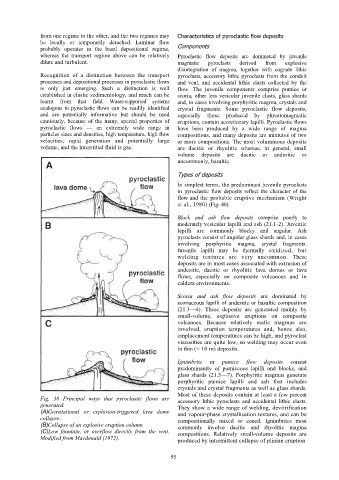
               Fig.  38 Principal ways that  pyroclastic flows  are   accessory lithic pyroclasts and accidental lithic clasts.
               generated.                                      They show a wide range of welding, devitrification
               (A) Gravitational or explosion-triggered lava dome   and vapour-phase crystallisation textures, and can be
               collapse.                                       compositionally mixed or  zoned. Ignimbrites most
               (B) Collapse of an explosive eruption column.   commonly  involve  dacitic and rhyolitic magma
               (C)Low fountain, or  overflow directly  from the  vent.   compositions. Relatively small-volume  deposits  are
               Modified from Macdonald (1972).                 produced by intermittent collapse of plinian eruption

                                                             95

