


Page 261 - Materials Chemistry, Second Edition
P. 261
CAT3525_C08.qxd  1/29/2005  10:03 AM  Page 232
                       232                       Waste Management Practices: Municipal, Hazardous, and Industrial
                       C:N ratio is maintained within the desired range, little excess N will leach from the pile since this
                       is rapidly utilized by microorganisms for growth (U.S. EPA, 1994).
                          The installation of a concrete pad for a compost base is valuable for collection and control of
                       any leachate produced. A simple method to handle leachate is to collect all liquids from the pad and
                       reintroduce them into the pile. Such leachate recycling should not be conducted once the compost
                       pile has completed the high-temperature phase, as any harmful microorganisms that were inacti-
                       vated by the high heat can be reintroduced with the leachate (CC, 1991). Leachate can also be trans-
                       ported to a municipal wastewater treatment plant. If the contaminant levels in the leachate are too
                       high, an on-site wastewater pretreatment system could be installed (U.S. EPA, 1994).
                       Measures to control leachate include:

                           ● Diverting from the compost curing and storage areas to a leachate holding area
                           ● Installing liner systems made of low-permeability soils such as clay or synthetic materials
                           ● Using drain pipes to collect the leachate for treatment
                           ● Curing and storing compost indoors to eliminate infiltration of leachate into the ground
                             (Wirth, 1989)

                       8.8.6 RUNOFF
                       Runoff is caused by heavy precipitation, by components within the feedstock, and by practices at the
                       facility that use water. For example, the water used to wash trucks can contribute to runoff. Polluted
                       water can be spilled in the tipping area of composting facilities when packer trucks from restaurants,
                       grocery stores, and food processors are emptied. Operations that compost MSW and yard waste can
                       produce runoff containing measurable quantities of inorganic nutrients and other pollutants.
                          For both yard waste and MSW composting facilities, water that has come into contact with
                       incoming raw materials, partially processed materials, or compost should not be allowed to run off
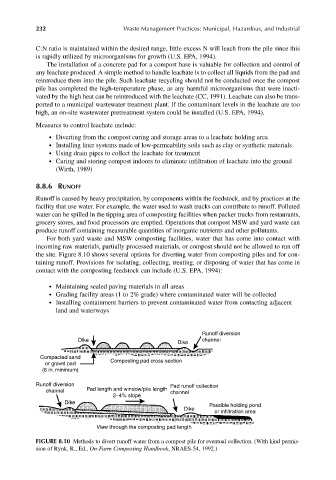
                       the site. Figure 8.10 shows several options for diverting water from composting piles and for con-
                       taining runoff. Provisions for isolating, collecting, treating, or disposing of water that has come in
                       contact with the composting feedstock can include (U.S. EPA, 1994):

                           ● Maintaining sealed paving materials in all areas
                           ● Grading facility areas (1 to 2% grade) where contaminated water will be collected
                           ● Installing containment barriers to prevent contaminated water from contacting adjacent
                             land and waterways


                                                                        Runoff diversion
                                   Dike                          Dike   channel

                        Compacted sand
                         or gravel pad       Composting pad cross section
                        (6 in. minimum)

                       Runoff diversion                        Pad runoff collection
                          channel     Pad length and window/pile length  channel
                                              2−4% slope
                               Dike
                                                                           Possible holding pond
                                                                   Dike
                                                                            or infiltration area
                                         View through the composting pad length

                       FIGURE 8.10 Methods to divert runoff water from a compost pile for eventual collection. (With kind permis-
                       sion of Rynk, R., Ed., On-Farm Composting Handbook, NRAES-54, 1992.)

