


Page 305 - Water Engineering Hydraulics, Distribution and Treatment
P. 305
9.4 Methods and Devices for the Prevention of Backflow and Backsiphonage
                                                                                             Test cock
                                                                                         First check valve
                                                                                              Test cock
                                                                                                        3         Gate valve Spring Gate valve 283
                                                                                                        / 4  inch thru 2 inches
                                                                                                        1
                                                                                                       2 / 2  inches thru 10 inches


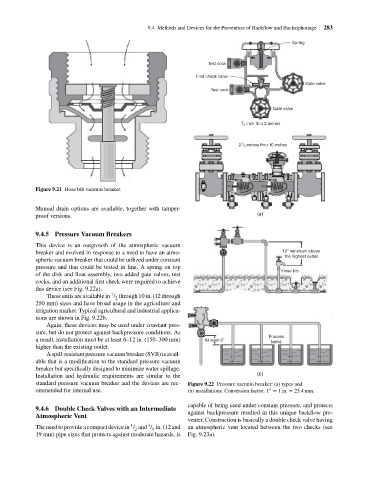
                                    Figure 9.21 Hose bib vacuum breaker.


                                    Manual drain options are available, together with tamper-
                                    proof versions.                                                          (a)


                                    9.4.5 Pressure Vacuum Breakers
                                    This device is an outgrowth of the atmospheric vacuum
                                    breaker and evolved in response to a need to have an atmo-                       12˝ minimum above
                                                                                                                      the highest outlet
                                    spheric vacuum breaker that could be utilized under constant
                                    pressure and that could be tested in line. A spring on top
                                                                                                                     Hose bib
                                    of the disk and float assembly, two added gate valves, test
                                    cocks, and an additional first check were required to achieve
                                    this device (see Fig. 9.22a).
                                                             1
                                       These units are available in / through 10 in. (12 through
                                                              2
                                    250 mm) sizes and have broad usage in the agriculture and
                                    irrigation market. Typical agricultural and industrial applica-
                                    tions are shown in Fig. 9.22b.
                                       Again, these devices may be used under constant pres-
                                    sure, but do not protect against backpressure conditions. As
                                                                                                                 Process
                                    a result, installation must be at least 6–12 in. (150–300 mm)  At least 6˝    tanks
                                    higher than the existing outlet.
                                       A spill-resistant pressure vacuum breaker (SVB) is avail-
                                    able that is a modification to the standard pressure vacuum
                                    breaker but specifically designed to minimize water spillage.
                                    Installation and hydraulic requirements are similar to the               (b)
                                    standard pressure vacuum breaker and the devices are rec-  Figure 9.22 Pressure vacuum breaker: (a) types and
                                    ommended for internal use.                        (b) installations. Conversion factor: 1 = 1in. = 25.4mm.
                                                                                                                 ′′
                                                                                      capable of being used under constant pressure, and protects
                                    9.4.6 Double Check Valves with an Intermediate
                                    Atmospheric Vent                                  against backpressure resulted in this unique backflow pre-
                                                                                      venter. Construction is basically a double check valve having
                                                                         3
                                                                   1
                                    The need to provide a compact device in / and / in. (12 and  an atmospheric vent located between the two checks (see
                                                                     2
                                                                          4
                                    19 mm) pipe sizes that protects against moderate hazards, is  Fig. 9.23a).

