


Page 458 - Wind Energy Handbook
P. 458
432                                                     COMPONENT DESIGN


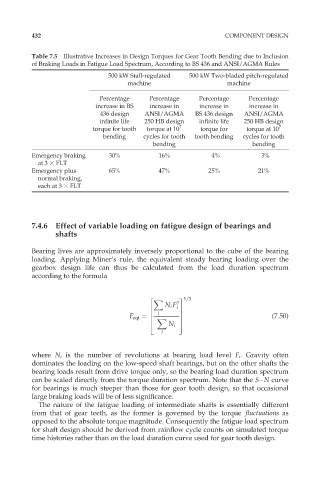
          Table 7.5 Illustrative Increases in Design Torques for Gear Tooth Bending due to Inclusion
          of Braking Loads in Fatigue Load Spectrum, According to BS 436 and ANSI/AGMA Rules
                                500 kW Stall-regulated  500 kW Two-bladed pitch-regulated
                                      machine                      machine

                              Percentage    Percentage    Percentage     Percentage
                             increase in BS  increase in   increase in   increase in
                              436 design   ANSI/AGMA     BS 436 design  ANSI/AGMA
                              infinite life  250 HB design  infinite life  250 HB design
                            torque for tooth  torque at 10 7  torque for  torque at 10 7
                               bending    cycles for tooth  tooth bending  cycles for tooth
                                             bending                      bending
          Emergency braking     30%            16%            4%            3%
            at 3 3 FLT
          Emergency plus        65%            47%           25%           21%
            normal braking,
            each at 3 3 FLT


          7.4.6 Effect of variable loading on fatigue design of bearings and
                 shafts

          Bearing lives are approximately inversely proportional to the cube of the bearing
          loading. Applying Miner’s rule, the equivalent steady bearing loading over the
          gearbox design life can thus be calculated from the load duration spectrum
          according to the formula


                                            2 X      3 1=3
                                                 N i F 3
                                            6       i  7
                                            6
                                                     7
                                               i
                                      F eqt ¼ 6  X   7                         (7:50)
                                            4        5
                                                  N i
                                                i
          where N i is the number of revolutions at bearing load level F i . Gravity often
          dominates the loading on the low-speed shaft bearings, but on the other shafts the
          bearing loads result from drive torque only, so the bearing load duration spectrum
          can be scaled directly from the torque duration spectrum. Note that the S–N curve
          for bearings is much steeper than those for gear tooth design, so that occasional
          large braking loads will be of less significance.
            The nature of the fatigue loading of intermediate shafts is essentially different
          from that of gear teeth, as the former is governed by the torque fluctuations as
          opposed to the absolute torque magnitude. Consequently the fatigue load spectrum
          for shaft design should be derived from rainflow cycle counts on simulated torque
          time histories rather than on the load duration curve used for gear tooth design.

