


Page 460 - Wind Energy Handbook
P. 460
434                                                     COMPONENT DESIGN

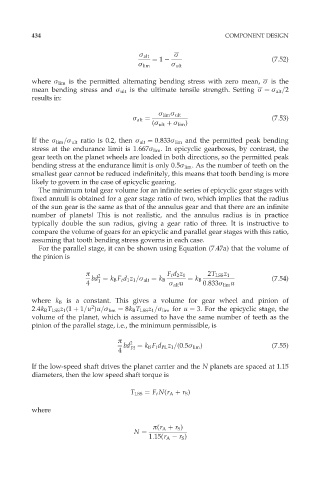
                                                   ó
                                         ó alt
                                             ¼ 1                               (7:52)
                                         ó lim    ó ult
          where ó lim is the permitted alternating bending stress with zero mean, ó is the
          mean bending stress and ó ult is the ultimate tensile strength. Setting ó ¼ ó alt =2
          results in:

                                               ó lim ó ult
                                       ó alt ¼                                 (7:53)
                                             (ó ult þ ó lim )

          If the ó lim =ó ult ratio is 0.2, then ó alt ¼ 0:833ó lim and the permitted peak bending
          stress at the endurance limit is 1:667ó lim . In epicyclic gearboxes, by contrast, the
          gear teeth on the planet wheels are loaded in both directions, so the permitted peak
          bending stress at the endurance limit is only 0:5ó lim . As the number of teeth on the
          smallest gear cannot be reduced indefinitely, this means that tooth bending is more
          likely to govern in the case of epicyclic gearing.
            The minimum total gear volume for an infinite series of epicyclic gear stages with
          fixed annuli is obtained for a gear stage ratio of two, which implies that the radius
          of the sun gear is the same as that of the annulus gear and that there are an infinite
          number of planets! This is not realistic, and the annulus radius is in practice
          typically double the sun radius, giving a gear ratio of three. It is instructive to
          compare the volume of gears for an epicyclic and parallel gear stages with this ratio,
          assuming that tooth bending stress governs in each case.
            For the parallel stage, it can be shown using Equation (7.47a) that the volume of
          the pinion is

                          ð  2                   F t d 2 z 1  2T LSS z 1
                           bd ¼ k B F t d 1 z 1 =ó alt ¼ k B  ¼ k B            (7:54)
                             1
                          4                       ó alt u   0:833ó lim u
          where k B is a constant. This gives a volume for gear wheel and pinion of
                           2
          2:4k B T LSS z 1 (1 þ 1=u )u=ó lim ¼ 8k B T LSS z 1 =ó lim for u ¼ 3. For the epicyclic stage, the
          volume of the planet, which is assumed to have the same number of teeth as the
          pinion of the parallel stage, i.e., the minimum permissible, is

                                   ð   2
                                     bd Pl  ¼ k B F t d PL z 1 =(0:5ó lim )    (7:55)
                                   4

          If the low-speed shaft drives the planet carrier and the N planets are spaced at 1.15
          diameters, then the low speed shaft torque is

                                       T LSS ¼ F t N(r A þ r S )

          where

                                             ð(r A þ r S )
                                        N ¼
                                            1:15(r A   r S )

