


Page 461 - Wind Energy Handbook
P. 461
GEARBOX                                                                435


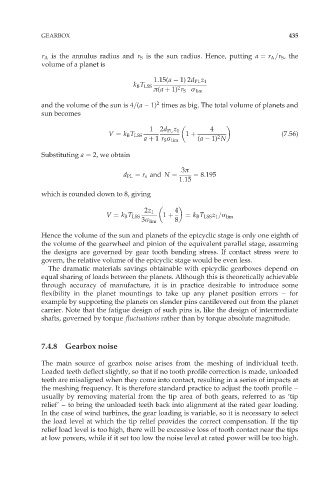
             r A is the annulus radius and r S is the sun radius. Hence, putting a ¼ r A =r S , the
             volume of a planet is

                                             1:15(a   1) 2d PL z 1
                                       k B T LSS    2
                                             ð(a þ 1) r S ó lim
                                              2
             and the volume of the sun is 4=(a   1) times as big. The total volume of planets and
             sun becomes

                                            1  2d PL z 1      4
                                V ¼ k B T LSS          1 þ      2                 (7:56)
                                           a þ 1 r S ó lim  (a   1) N
             Substituting a ¼ 2, we obtain

                                                     3ð
                                     d PL ¼ r s and N ¼  ¼ 8:195
                                                     1:15
             which is rounded down to 8, giving

                                                   4
                                           2z 1
                                V ¼ k B T LSS   1 þ   ¼ k B T LSS z 1 =ó lim
                                          3ó lim   8
             Hence the volume of the sun and planets of the epicyclic stage is only one eighth of
             the volume of the gearwheel and pinion of the equivalent parallel stage, assuming
             the designs are governed by gear tooth bending stress. If contact stress were to
             govern, the relative volume of the epicyclic stage would be even less.
               The dramatic materials savings obtainable with epicyclic gearboxes depend on
             equal sharing of loads between the planets. Although this is theoretically achievable
             through accuracy of manufacture, it is in practice desirable to introduce some
             flexibility in the planet mountings to take up any planet position errors – for
             example by supporting the planets on slender pins cantilevered out from the planet
             carrier. Note that the fatigue design of such pins is, like the design of intermediate
             shafts, governed by torque fluctuations rather than by torque absolute magnitude.


             7.4.8  Gearbox noise

             The main source of gearbox noise arises from the meshing of individual teeth.
             Loaded teeth deflect slightly, so that if no tooth profile correction is made, unloaded
             teeth are misaligned when they come into contact, resulting in a series of impacts at
             the meshing frequency. It is therefore standard practice to adjust the tooth profile –
             usually by removing material from the tip area of both gears, referred to as ‘tip
             relief’ – to bring the unloaded teeth back into alignment at the rated gear loading.
             In the case of wind turbines, the gear loading is variable, so it is necessary to select
             the load level at which the tip relief provides the correct compensation. If the tip
             relief load level is too high, there will be excessive loss of tooth contact near the tips
             at low powers, while if it set too low the noise level at rated power will be too high.

