


Page 487 - Wind Energy Handbook
P. 487
TOWER                                                                  461


             the extreme load, with the result that the bolts are not subject to fatigue loads.
             Unfortunately, apart from the effect of splice plates on the external appearance,
             there are practical difficulties of joint assembly, because bolting requires the
             provision of some form of personnel access on the outside of the tower. Neverthe-
             less splice plates are used on some towers.
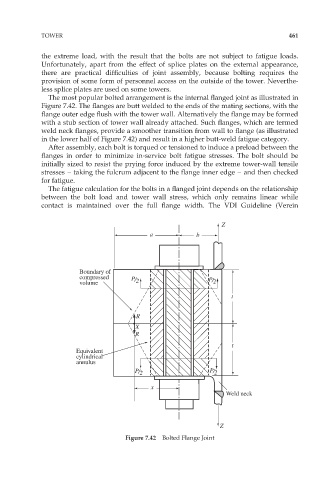
               The most popular bolted arrangement is the internal flanged joint as illustrated in
             Figure 7.42. The flanges are butt welded to the ends of the mating sections, with the
             flange outer edge flush with the tower wall. Alternatively the flange may be formed
             with a stub section of tower wall already attached. Such flanges, which are termed
             weld neck flanges, provide a smoother transition from wall to flange (as illustrated
             in the lower half of Figure 7.42) and result in a higher butt-weld fatigue category.
               After assembly, each bolt is torqued or tensioned to induce a preload between the
             flanges in order to minimize in-service bolt fatigue stresses. The bolt should be
             initially sized to resist the prying force induced by the extreme tower-wall tensile
             stresses – taking the fulcrum adjacent to the flange inner edge – and then checked
             for fatigue.
               The fatigue calculation for the bolts in a flanged joint depends on the relationship
             between the bolt load and tower wall stress, which only remains linear while
             contact is maintained over the full flange width. The VDI Guideline (Verein


                                                                 Z
                                            a             b


                        Boundary of
                        compressed
                        volume         P/ 2                  P/ 2
                                                                    t

                                        R
                                        X
                                        R
                                                                    t
                       Equivalent
                       cylindrical
                       annulus
                                        P/ 2                  P/ 2
                                             x
                                                                  Weld neck


                                                                Z
                                     Figure 7.42  Bolted Flange Joint

