


Page 485 - Wind Energy Handbook
P. 485
TOWER                                                                  459


             platform and cable support members and the horizontal welds to the tower base
             flange and intermediate bolted flanges. Assuming a full penetration butt weld is
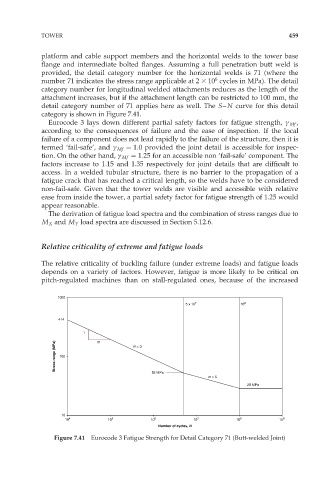
             provided, the detail category number for the horizontal welds is 71 (where the
                                                               6
             number 71 indicates the stress range applicable at 2 3 10 cycles in MPa). The detail
             category number for longitudinal welded attachments reduces as the length of the
             attachment increases, but if the attachment length can be restricted to 100 mm, the
             detail category number of 71 applies here as well. The S–N curve for this detail
             category is shown in Figure 7.41.
               Eurocode 3 lays down different partial safety factors for fatigue strength, ª Mf ,
             according to the consequences of failure and the ease of inspection. If the local
             failure of a component does not lead rapidly to the failure of the structure, then it is
             termed ‘fail-safe’, and ª Mf ¼ 1:0 provided the joint detail is accessible for inspec-
             tion. On the other hand, ª Mf ¼ 1:25 for an accessible non ‘fail-safe’ component. The
             factors increase to 1.15 and 1.35 respectively for joint details that are difficult to
             access. In a welded tubular structure, there is no barrier to the propagation of a
             fatigue crack that has reached a critical length, so the welds have to be considered
             non-fail-safe. Given that the tower welds are visible and accessible with relative
             ease from inside the tower, a partial safety factor for fatigue strength of 1.25 would
             appear reasonable.
               The derivation of fatigue load spectra and the combination of stress ranges due to
             M X and M Y load spectra are discussed in Section 5.12.6.


             Relative criticality of extreme and fatigue loads

             The relative criticality of buckling failure (under extreme loads) and fatigue loads
             depends on a variety of factors. However, fatigue is more likely to be critical on
             pitch-regulated machines than on stall-regulated ones, because of the increased

                  1000
                                                       5 x 10 7                                                           10 8

                  414

                         1   m
                 Stress range (MPa)  100  m = 3


                                             52 MPa
                                                             m = 5
                                                                        29 MPa


                   10
                    10 4        10 5        10 6         10 7        10 8         10 9
                                               Number of cycles, N
                 Figure 7.41  Eurocode 3 Fatigue Strength for Detail Category 71 (Butt-welded Joint)

