


Page 480 - Wind Energy Handbook
P. 480
454                                                     COMPONENT DESIGN


          site, which has not normally proved economic. Accordingly, this section concen-
          trates on the two types of steel towers – tubular and lattice. The restrictions on first-
          mode natural frequency are considered first.


          7.9.2 Constraints on first-mode natural frequency

          As noted in Section 6.14, it is important to avoid the excitation of resonant tower
          oscillations by rotor thrust fluctuations at blade-passing frequency or, to a lesser
          extent, at rotational frequency. Dynamic magnification impacts directly on fatigue
          loads, so the further the first-mode tower natural frequency is from the exciting
          frequencies, the better. Unfortunately, it is generally the case that the natural
          frequency of a tower designed to be of adequate strength for extreme loads is of the
          same order of magnitude as the blade-passing frequency.
            In the case of machines operating at one of two fixed speeds, the latitude
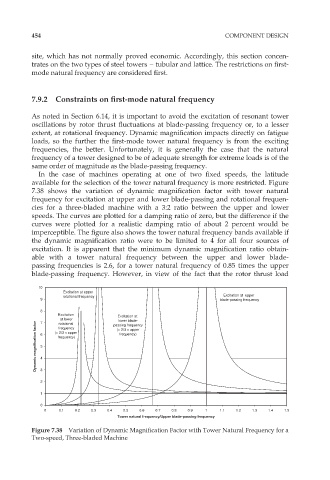
          available for the selection of the tower natural frequency is more restricted. Figure
          7.38 shows the variation of dynamic magnification factor with tower natural
          frequency for excitation at upper and lower blade-passing and rotational frequen-
          cies for a three-bladed machine with a 3:2 ratio between the upper and lower
          speeds. The curves are plotted for a damping ratio of zero, but the difference if the
          curves were plotted for a realistic damping ratio of about 2 percent would be
          imperceptible. The figure also shows the tower natural frequency bands available if
          the dynamic magnification ratio were to be limited to 4 for all four sources of
          excitation. It is apparent that the minimum dynamic magnification ratio obtain-
          able with a tower natural frequency between the upper and lower blade-
          passing frequencies is 2.6, for a tower natural frequency of 0.85 times the upper
          blade-passing frequency. However, in view of the fact that the rotor thrust load

            10
                   Excitation at upper
                    rotational frequency                         Excitation at  upper
             9                                                   blade-passing frequency
             8
                  Excitation
                                   Excitation at
                   at lower       passing frequency
                                    lower blade-
           Dynamic magnification factor  6 5 4   frequency)   frequency)
             7
                  rotational
                   frequency
                                   (= 2/3 x upper
                 (= 2/3 x upper
             2 3

             1
             0
              0   0.1  0.2  0.3  0.4  0.5  0.6  0.7  0.8  0.9  1  1.1  1.2  1.3  1.4  1.5
                                   Tower natural frequency/Upper blade-passing frequency
          Figure 7.38 Variation of Dynamic Magnification Factor with Tower Natural Frequency for a
          Two-speed, Three-bladed Machine

