


Page 475 - Wind Energy Handbook
P. 475
MECHANICAL BRAKE                                                       449


             (b) Brake-disc diameter selection: The maximum rotor speed corresponds to a high-
                 speed shaft speed of 21:9 3 (1500=19) ¼ 1729 r:p:m: ¼ 181 rad=s, so the maxi-
                 mum permissible brake-disc radius as regards centrifugal stresses is about
                 90=181 ¼ 0:497 m. It is advisable to choose the largest permitted size in order
                 to minimize temperature rise, so 1.0 m diameter is selected in this case. The
                 pad rubbing speed will be quite acceptable if sintered pads are used.

             (c)  Selection of number and size of brake pads: The total brake-pad area is governed by
                 the need to keep the maximum power dissipation per unit pad area below
                            2
                 11.6 MW/m . The power dissipation is equal to the product of the braking
                 torque and the rotational speed, so it is at a maximum at the onset of braking,
                 i.e. 22:8 3 181 ¼ 4128 kW, giving a required total area of the brake pads of
                                     2
                 4128=11 600 ¼ 0:356 m . This area can be provided by four callipers fitted with
                                                2
                 0:22 3 0:22 m pads, giving 0.387 m in all.
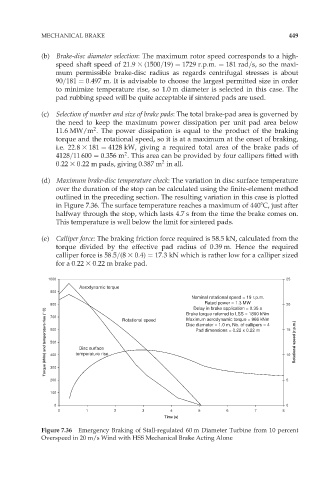
             (d) Maximum brake-disc temperature check: The variation in disc surface temperature
                 over the duration of the stop can be calculated using the finite-element method
                 outlined in the preceding section. The resulting variation in this case is plotted
                 in Figure 7.36. The surface temperature reaches a maximum of 4408C, just after
                 halfway through the stop, which lasts 4.7 s from the time the brake comes on.
                 This temperature is well below the limit for sintered pads.
             (e) Calliper force: The braking friction force required is 58.5 kN, calculated from the
                 torque divided by the effective pad radius of 0.39 m. Hence the required
                 calliper force is 58:5=(8 3 0:4) ¼ 17:3 kN which is rather low for a calliper sized
                 for a 0:22 3 0:22 m brake pad.

               1000                                                                 25
                        Aerodynamic torque
                900
                                                        Nominal rotational speed = 19 r.p.m.
                                                            Rated power = 1.3 MW
                800                 Rotational speed   Brake torque referred to LSS = 1800 kNm  20
                                                         Delay in brake application = 0.35 s
              Torque (kNm) and temperature rise (  C)  600   temperature rise  Disc diameter = 1.0 m, No. of callipers = 4  15 Rotational speed (r.p.m.)
                700
                                                       Maximum aerodynamic torque = 966 kNm
                                                         Pad dimensions = 0.22 x 0.22 m
                500
                        Disc surface
                                                                                    10
                400
                300
                200                                                                 5
                100

                 0                                                                  0
                  0       1       2       3       4       5       6       7        8
                                                Time (s)
             Figure 7.36  Emergency Braking of Stall-regulated 60 m Diameter Turbine from 10 percent
             Overspeed in 20 m/s Wind with HSS Mechanical Brake Acting Alone

