


Page 473 - Wind Energy Handbook
P. 473
MECHANICAL BRAKE                                                       447


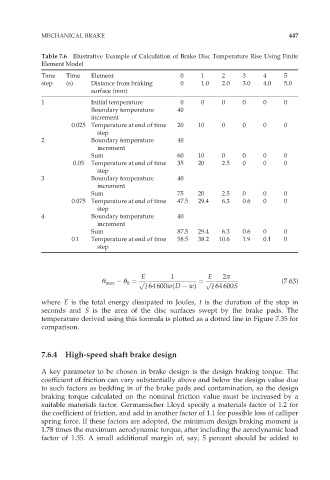
             Table 7.6  Illustrative Example of Calculation of Brake Disc Temperature Rise Using Finite
             Element Model
             Time   Time   Element                   0     1     2     3     4     5
             step   (s)    Distance from braking     0     1.0   2.0   3.0   4.0   5.0
                           surface (mm)
             1             Initial temperature       0     0     0     0     0     0
                           Boundary temperature     40
                           increment
                      0.025 Temperature at end of time  20  10   0     0     0     0
                             step
             2             Boundary temperature     40
                             increment
                           Sum                      60    10     0     0     0     0
                      0.05  Temperature at end of time  35  20   2.5   0     0     0
                             step
             3             Boundary temperature     40
                             increment
                           Sum                      75    20     2.5   0     0     0
                      0.075 Temperature at end of time  47.5  29.4  6.3  0.6  0    0
                             step
             4             Boundary temperature     40
                             increment
                           Sum                      87.5  29.4   6.3   0.6   0     0
                      0.1  Temperature at end of time  58.5  38.2  10.6  1.9  0.1  0
                             step


                                          E       1          E   2ð
                              Ł max   Ł 0 ¼ p ffiffi          ¼ p ffiffi                  (7:63)
                                           t 64 600w(D   w)   t 64 600S

             where E is the total energy dissipated in Joules, t is the duration of the stop in
             seconds and S is the area of the disc surfaces swept by the brake pads. The
             temperature derived using this formula is plotted as a dotted line in Figure 7.35 for
             comparison.


             7.6.4  High-speed shaft brake design

             A key parameter to be chosen in brake design is the design braking torque. The
             coefficient of friction can vary substantially above and below the design value due
             to such factors as bedding in of the brake pads and contamination, so the design
             braking torque calculated on the nominal friction value must be increased by a
             suitable materials factor. Germanischer Lloyd specify a materials factor of 1.2 for
             the coefficient of friction, and add in another factor of 1.1 for possible loss of calliper
             spring force. If these factors are adopted, the minimum design braking moment is
             1.78 times the maximum aerodynamic torque, after including the aerodynamic load
             factor of 1.35. A small additional margin of, say, 5 percent should be added to

