


Page 474 - Wind Energy Handbook
P. 474
448                                                     COMPONENT DESIGN


            900
            800                                   Nominal rotational speed  = 19 r.p.m.
                                                   Delay in brake operation = 0.35 s
                                                 Maximum aerodynamic torque = 966 kNm
            700                                  Disc diameter = 1.0 m, Pad width = 0.22 m
            600                                       Maximum temperature rise calculated from FE analysis
           Temperature rise (  C)  500                 Maximum temperature rise calculated from formula
                                                                - continuous line

            400
                                                             0.5
                                                           E/(t
                                                              ) x 1/(64600w(D-w)) - dotted line
            300
            200
            100

             0
              1      1.2    1.4    1.6   1.8     2     2.2    2.4    2.6    2.8    3
                                  Ratio of braking torque to maximum aerodynamic torque
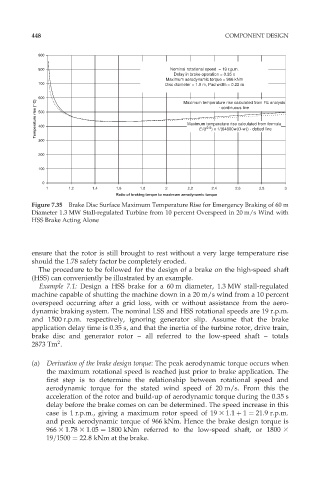
          Figure 7.35 Brake Disc Surface Maximum Temperature Rise for Emergency Braking of 60 m
          Diameter 1.3 MW Stall-regulated Turbine from 10 percent Overspeed in 20 m/s Wind with
          HSS Brake Acting Alone


          ensure that the rotor is still brought to rest without a very large temperature rise
          should the 1.78 safety factor be completely eroded.
            The procedure to be followed for the design of a brake on the high-speed shaft
          (HSS) can conveniently be illustrated by an example.
            Example 7.1: Design a HSS brake for a 60 m diameter, 1.3 MW stall-regulated
          machine capable of shutting the machine down in a 20 m/s wind from a 10 percent
          overspeed occurring after a grid loss, with or without assistance from the aero-
          dynamic braking system. The nominal LSS and HSS rotational speeds are 19 r.p.m.
          and 1500 r.p.m. respectively, ignoring generator slip. Assume that the brake
          application delay time is 0.35 s, and that the inertia of the turbine rotor, drive train,
          brake disc and generator rotor – all referred to the low-speed shaft – totals
                  2
          2873 Tm .

          (a)  Derivation of the brake design torque: The peak aerodynamic torque occurs when
              the maximum rotational speed is reached just prior to brake application. The
              first step is to determine the relationship between rotational speed and
              aerodynamic torque for the stated wind speed of 20 m/s. From this the
              acceleration of the rotor and build-up of aerodynamic torque during the 0.35 s
              delay before the brake comes on can be determined. The speed increase in this
              case is 1 r.p.m., giving a maximum rotor speed of 19 3 1:1 þ 1 ¼ 21:9r:p:m:
              and peak aerodynamic torque of 966 kNm. Hence the brake design torque is
              966 3 1:78 3 1:05 ¼ 1800 kNm referred to the low-speed shaft, or 1800 3
              19=1500 ¼ 22:8 kNm at the brake.

