


Page 478 - Wind Energy Handbook
P. 478
452                                                     COMPONENT DESIGN


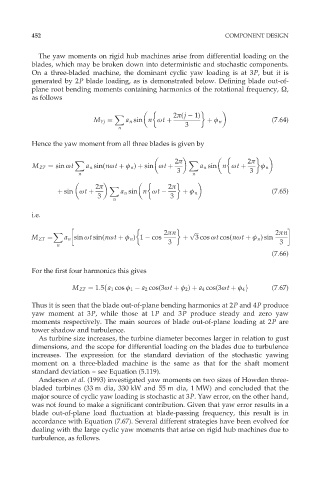
            The yaw moments on rigid hub machines arise from differential loading on the
          blades, which may be broken down into deterministic and stochastic components.
          On a three-bladed machine, the dominant cyclic yaw loading is at 3P, but it is
          generated by 2P blade loading, as is demonstrated below. Defining blade out-of-
          plane root bending moments containing harmonics of the rotational frequency, Ù,
          as follows

                                  X                2ð(j   1)
                            M Yj ¼   a n sin n øt þ          þ ö n             (7:64)
                                                      3
                                   n
          Hence the yaw moment from all three blades is given by


                       X                           2ð  X                2ð
          M ZT ¼ sin øt   a n sin(nøt þ ö n ) þ sin øt þ   a n sin n øt þ   ö n
                                                    3                    3
                        n                                n

                             2ð  X                2ð
                  þ sin øt þ        a n sin n øt      þ ö n                    (7:65)
                             3                    3
                                  n
          i.e.

                X                               2ðn     p ffiffiffi                   2ðn
          M ZT ¼    a n sin øt sin(nøt þ ö n )1   cos  þ  3 cos øt cos(nøt þ ö n ) sin
                                                  3                               3
                 n
                                                                               (7:66)

          For the first four harmonics this gives

                      M ZT ¼ 1:5fa 1 cos ö 1   a 2 cos(3øt þ ö 2 ) þ a 4 cos(3øt þ ö 4 g  (7:67)

          Thus it is seen that the blade out-of-plane bending harmonics at 2P and 4P produce
          yaw moment at 3P, while those at 1P and 3P produce steady and zero yaw
          moments respectively. The main sources of blade out-of-plane loading at 2P are
          tower shadow and turbulence.
            As turbine size increases, the turbine diameter becomes larger in relation to gust
          dimensions, and the scope for differential loading on the blades due to turbulence
          increases. The expression for the standard deviation of the stochastic yawing
          moment on a three-bladed machine is the same as that for the shaft moment
          standard deviation – see Equation (5.119).
            Anderson et al. (1993) investigated yaw moments on two sizes of Howden three-
          bladed turbines (33 m dia, 330 kW and 55 m dia, 1 MW) and concluded that the
          major source of cyclic yaw loading is stochastic at 3P. Yaw error, on the other hand,
          was not found to make a significant contribution. Given that yaw error results in a
          blade out-of-plane load fluctuation at blade-passing frequency, this result is in
          accordance with Equation (7.67). Several different strategies have been evolved for
          dealing with the large cyclic yaw moments that arise on rigid hub machines due to
          turbulence, as follows.

