


Page 483 - Wind Energy Handbook
P. 483
TOWER                                                                  457


             These values apply if the out-of-plane deviations, w, of the cylinder measured with
             either
                                   p ffiffiffiffi
             (a) a rod of length L ¼ 4 rt placed vertically, away from welds, or

             (b) a circular template of the same length placed horizontally, away from welds, or
             (c) a rod of length L ¼ 25t placed vertically across horizontal welds,

             do not exceed 1 percent of the respective rod or template length. The value of Æ B is
             halved if the maximum value of the imperfection ratio, w=L, is 2 percent, and may
             be interpolated for intermediate values of w=L.
               The buckling strength, ó u , is then given in terms of the yield strength and the
             elastic critical buckling stress (Equation (7.68)) as follows
                   "                   #
                                 f y  0:6
             ó u ¼ f y 1   0:4123       for Æ B ó cr . f y =2 and ó u ¼ 0:75Æ B ó cr for Æ B ó cr , f y =2
                               Æ B ó cr
                                                                                  (7:71)

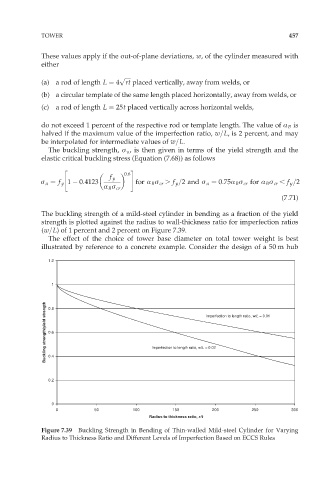
             The buckling strength of a mild-steel cylinder in bending as a fraction of the yield
             strength is plotted against the radius to wall-thickness ratio for imperfection ratios
             (w=L) of 1 percent and 2 percent on Figure 7.39.
               The effect of the choice of tower base diameter on total tower weight is best
             illustrated by reference to a concrete example. Consider the design of a 50 m hub

               1.2


                1

              Buckling strength/yield strength  0.6  Imperfection to length ratio, w/L = 0.02
               0.8
                                                            Imperfection to length ratio, w/L = 0.01


               0.4


               0.2


                0
                 0          50         100         150        200         250        300
                                            Radius to thickness ratio, r/t
             Figure 7.39  Buckling Strength in Bending of Thin-walled Mild-steel Cylinder for Varying
             Radius to Thickness Ratio and Different Levels of Imperfection Based on ECCS Rules

