


Page 477 - Wind Energy Handbook
P. 477
YAW DRIVE                                                              451


             supports the low-speed shaft main bearing at the front and the port and starboard
             gearbox supports towards the rear, with the generator mounted on a fabricated
             platform projecting to the rear and attached to the main casting by bolts.
               Although conventional methods of analysis can be used to design the bedplate
             for extreme loads, the complicated shape renders a finite-element analysis essential
             for calculating the stress concentration effects needed for fatigue design. Fatigue
             analysis is complicated by the need to take into account up to six rotor load
             components. However, given stress distributions for each load component obtained
             by separate FE analyses, the stress-time history at any point can be obtained by
             combining appropriately scaled load component time histories previously obtained
             from a load case simulation.


             7.8   Yaw Drive


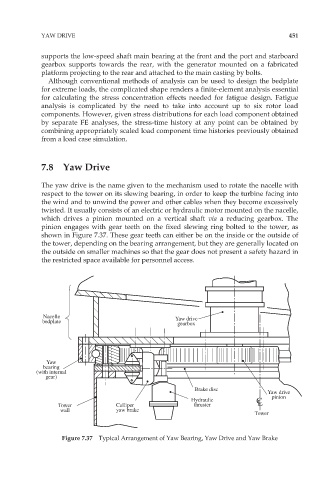
             The yaw drive is the name given to the mechanism used to rotate the nacelle with
             respect to the tower on its slewing bearing, in order to keep the turbine facing into
             the wind and to unwind the power and other cables when they become excessively
             twisted. It usually consists of an electric or hydraulic motor mounted on the nacelle,
             which drives a pinion mounted on a vertical shaft via a reducing gearbox. The
             pinion engages with gear teeth on the fixed slewing ring bolted to the tower, as
             shown in Figure 7.37. These gear teeth can either be on the inside or the outside of
             the tower, depending on the bearing arrangement, but they are generally located on
             the outside on smaller machines so that the gear does not present a safety hazard in
             the restricted space available for personnel access.


             Nacelle                                Yaw drive
             bedplate                               gearbox


              Yaw
             bearing
           (with internal
              gear)
                                                         Brake disc
                                                                              Yaw drive
                                                                               pinion
                                                        Hydraulic          C
                  Tower            Calliper              thruster           L
                  wall             yaw brake
                                                                           Tower
                   Figure 7.37  Typical Arrangement of Yaw Bearing, Yaw Drive and Yaw Brake

