


Page 472 - Wind Energy Handbook
P. 472
446                                                     COMPONENT DESIGN

                                                   2
                                         dŁ     k d Ł
                                            ¼                                  (7:59)
                                         dt   rC p dx 2

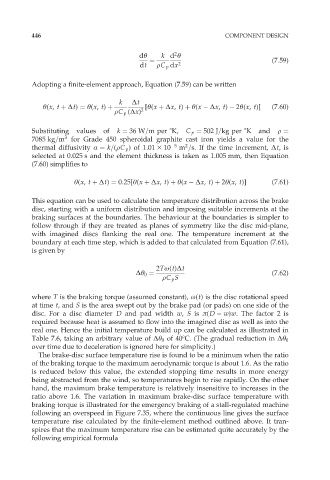
          Adopting a finite-element approach, Equation (7.59) can be written

                                   k   ˜t
             Ł(x, t þ ˜t) ¼ Ł(x, t) þ      [Ł(x þ ˜x, t) þ Ł(x   ˜x, t)   2Ł(x, t)]  (7:60)
                                  rC p (˜x) 2

          Substituting  values  of  k ¼ 36 W=m per 8K,  C p ¼ 502 J=kg per 8K  and  r ¼
                    3
          7085 kg=m for Grade 450 spheroidal graphite cast iron yields a value for the
                                                      2
          thermal diffusivity Æ ¼ k=(rC p )of 1:01 3 10  5  m =s. If the time increment, ˜t,is
          selected at 0.025 s and the element thickness is taken as 1.005 mm, then Equation
          (7.60) simplifies to

                      Ł(x, t þ ˜t) ¼ 0:25[Ł(x þ ˜x, t) þ Ł(x   ˜x, t) þ 2Ł(x, t)]  (7:61)


          This equation can be used to calculate the temperature distribution across the brake
          disc, starting with a uniform distribution and imposing suitable increments at the
          braking surfaces at the boundaries. The behaviour at the boundaries is simpler to
          follow through if they are treated as planes of symmetry like the disc mid-plane,
          with imagined discs flanking the real one. The temperature increment at the
          boundary at each time step, which is added to that calculated from Equation (7.61),
          is given by

                                              2Tø(t)˜t
                                        ˜Ł 0 ¼                                 (7:62)
                                                rC p S

          where T is the braking torque (assumed constant), ø(t) is the disc rotational speed
          at time t, and S is the area swept out by the brake pad (or pads) on one side of the
          disc. For a disc diameter D and pad width w, S is ð(D   w)w. The factor 2 is
          required because heat is assumed to flow into the imagined disc as well as into the
          real one. Hence the initial temperature build up can be calculated as illustrated in
          Table 7.6, taking an arbitrary value of ˜Ł 0 of 408C. (The gradual reduction in ˜Ł 0
          over time due to deceleration is ignored here for simplicity.)
            The brake-disc surface temperature rise is found to be a minimum when the ratio
          of the braking torque to the maximum aerodynamic torque is about 1.6. As the ratio
          is reduced below this value, the extended stopping time results in more energy
          being abstracted from the wind, so temperatures begin to rise rapidly. On the other
          hand, the maximum brake temperature is relatively insensitive to increases in the
          ratio above 1.6. The variation in maximum brake-disc surface temperature with
          braking torque is illustrated for the emergency braking of a stall-regulated machine
          following an overspeed in Figure 7.35, where the continuous line gives the surface
          temperature rise calculated by the finite-element method outlined above. It tran-
          spires that the maximum temperature rise can be estimated quite accurately by the
          following empirical formula

