


Page 467 - Wind Energy Handbook
P. 467
GENERATOR                                                              441


               The equations used to describe the steady-state performance of induction gen-
             erators are given in any standard undergraduate textbook (e.g. Hindmarsh, 1984,
             and McPherson, 1990). Dynamic analysis is more complex but is dealt with by
             Krause (1986).


             7.5.2  Variable-speed generators

             There are two fundamental approaches to electrical variable-speed operation. Either
             all the output power of the wind turbine may be passed through the frequency
             converter to give a broad range of variable speed operation or a restricted speed
             range may be achieved by converting only a fraction of the output power.
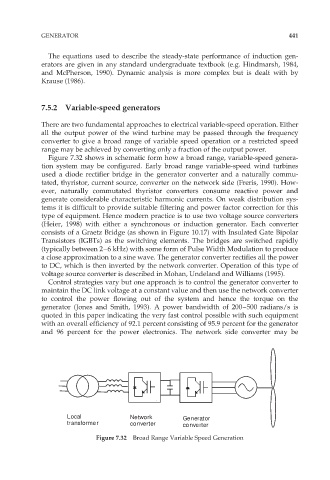
               Figure 7.32 shows in schematic form how a broad range, variable-speed genera-
             tion system may be configured. Early broad range variable-speed wind turbines
             used a diode rectifier bridge in the generator converter and a naturally commu-
             tated, thyristor, current source, converter on the network side (Freris, 1990). How-
             ever, naturally commutated thyristor converters consume reactive power and
             generate considerable characteristic harmonic currents. On weak distribution sys-
             tems it is difficult to provide suitable filtering and power factor correction for this
             type of equipment. Hence modern practice is to use two voltage source converters
             (Heier, 1998) with either a synchronous or induction generator. Each converter
             consists of a Graetz Bridge (as shown in Figure 10.17) with Insulated Gate Bipolar
             Transistors (IGBTs) as the switching elements. The bridges are switched rapidly
             (typically between 2–6 kHz) with some form of Pulse Width Modulation to produce
             a close approximation to a sine wave. The generator converter rectifies all the power
             to DC, which is then inverted by the network converter. Operation of this type of
             voltage source converter is described in Mohan, Undeland and Williams (1995).
               Control strategies vary but one approach is to control the generator converter to
             maintain the DC link voltage at a constant value and then use the network converter
             to control the power flowing out of the system and hence the torque on the
             generator (Jones and Smith, 1993). A power bandwidth of 200–500 radians/s is
             quoted in this paper indicating the very fast control possible with such equipment
             with an overall efficiency of 92.1 percent consisting of 95.9 percent for the generator
             and 96 percent for the power electronics. The network side converter may be


                    Local              Network        Generator
                    transformer        converter      converter
                             Figure 7.32  Broad Range Variable Speed Generation

