


Page 451 - The ISA Handbook in Contemporary Sociology
P. 451
9781412934633-Chap-28  1/10/09  8:58 AM  Page 422


                   422               THE ISA HANDBOOK IN CONTEMPORARY SOCIOLOGY


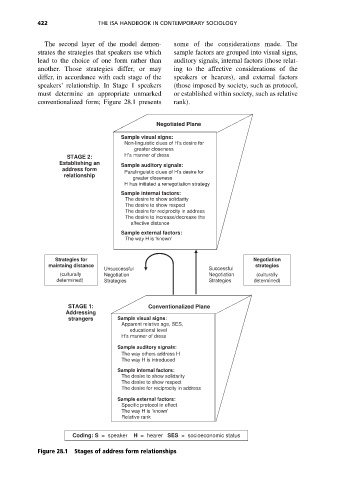
                     The second layer of the model demon-  some of the considerations made.  The
                   strates the strategies that speakers use which  sample factors are grouped into visual signs,
                   lead to the choice of one form rather than  auditory signals, internal factors (those relat-
                   another.  Those strategies differ, or may  ing to the affective considerations of the
                   differ, in accordance with each stage of the  speakers or hearers), and external factors
                   speakers’ relationship. In Stage 1 speakers  (those imposed by society, such as protocol,
                   must determine an appropriate unmarked  or established within society, such as relative
                   conventionalized form; Figure 28.1 presents  rank).


                                                      Negotiated Plane
                                           Sample visual signs:
                                            Non-linguistic clues of H’s desire for
                                                   greater closeness
                            STAGE 2:        H’s manner of dress
                         Establishing an   Sample auditory signals:
                          address form      Paralinguistic clues of H’s desire for
                           relationship
                                                  greater closeness
                                            H has initiated a renegotiation strategy
                                           Sample internal factors:
                                             The desire to show solidarity
                                             The desire to show respect
                                             The desire for reciprocity in address
                                             The desire to increase/decrease the
                                                 affective distance
                                           Sample external factors:
                                             The way H is ‘known’


                        Strategies for                                            Negotiation
                      maintaing distance                                          strategies
                                      Unsuccessful                   Successful
                          (culturally  Negotiation                   Negotiation   (culturally
                         determined)   Strategies                    Strategies   determined)


                            STAGE 1:               Conventionalized Plane
                           Addressing
                            strangers     Sample visual signs:
                                            Apparent relative age, SES,
                                                  educational level
                                            H’s manner of dress
                                          Sample auditory signals:
                                            The way others address H
                                            The way H is introduced
                                          Sample internal factors:
                                            The desire to show solidarity
                                            The desire to show respect
                                            The desire for reciprocity in address
                                          Sample external factors:
                                            Specific protocol in effect
                                            The way H is ‘known’
                                            Relative rank

                             Coding: S  =  speaker    H  =  hearer   SES  =  socioeconomic status

                   Figure 28.1  Stages of address form relationships

