


Page 1057 - Advanced Organic Chemistry Part A - Structure and Mechanisms, 5th ed (2007) - Carey _ Sundberg
P. 1057
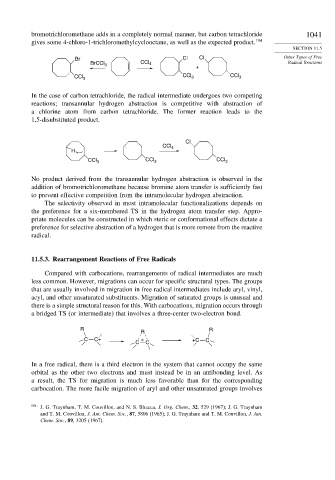
bromotrichloromethane adds in a completely normal manner, but carbon tetrachloride  1041
          gives some 4-chloro-1-trichloromethylcyclooctane, as well as the expected product. 194
                                                                                         SECTION 11.5
                       Br                               Cl   Cl                       Other Types of Free
                            BrCCl 3        CCl 4                                       Radical Reactions
                                                            +
                                                        CCl           CCl
                       CCl 3                               3             3

          In the case of carbon tetrachloride, the radical intermediate undergoes two competing
          reactions; transannular hydrogen abstraction is competitive with abstraction of
          a chlorine atom from carbon tetrachloride. The former reaction leads to the
          1,5-disubstituted product.


                                                         Cl
                          .            .          CCl 4
                      H
                           CCl 3             CCl 3                CCl 3

          No product derived from the transannular hydrogen abstraction is observed in the
          addition of bromotrichloromethane because bromine atom transfer is sufficiently fast
          to prevent effective competition from the intramolecular hydrogen abstraction.
              The selectivity observed in most intramolecular functionalizations depends on
          the preference for a six-membered TS in the hydrogen atom transfer step. Appro-
          priate molecules can be constructed in which steric or conformational effects dictate a
          preference for selective abstraction of a hydrogen that is more remote from the reactive
          radical.


          11.5.3. Rearrangement Reactions of Free Radicals

              Compared with carbocations, rearrangements of radical intermediates are much
          less common. However, migrations can occur for specific structural types. The groups
          that are usually involved in migration in free radical intermediates include aryl, vinyl,
          acyl, and other unsaturated substituents. Migration of saturated groups is unusual and
          there is a simple structural reason for this. With carbocations, migration occurs through
          a bridged TS (or intermediate) that involves a three-center two-electron bond.

                         R                                      R
                                           R
                          C  C+            +               +C  C
                                          C  C


          In a free radical, there is a third electron in the system that cannot occupy the same
          orbital as the other two electrons and must instead be in an antibonding level. As
          a result, the TS for migration is much less favorable than for the corresponding
          carbocation. The more facile migration of aryl and other unsaturated groups involves


          194
             J. G. Traynham, T. M. Couvillon, and N. S. Bhacca, J. Org. Chem., 32, 529 (1967); J. G. Traynham
             and T. M. Couvillon, J. Am. Chem. Soc., 87, 5806 (1965); J. G. Traynham and T. M. Couvillon, J. Am.
             Chem. Soc., 89, 3205 (1967).

