


Page 363 - Advances in Renewable Energies and Power Technologies
P. 363
336    CHAPTER 10 Scalar and Vector Control of Induction Motor


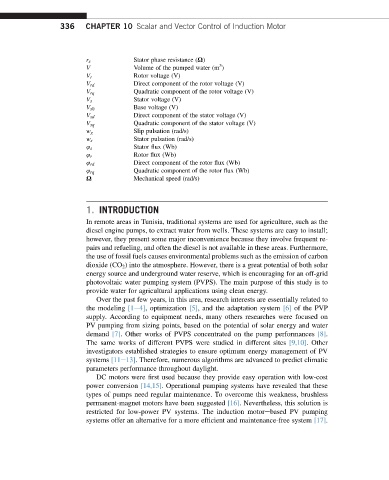
                         r s          Stator phase resistance (U)
                                                              3
                         V            Volume of the pumped water (m )
                         V r          Rotor voltage (V)
                         V rd         Direct component of the rotor voltage (V)
                         V rq         Quadratic component of the rotor voltage (V)
                         V s          Stator voltage (V)
                         V s0         Base voltage (V)
                         V sd         Direct component of the stator voltage (V)
                         V sq         Quadratic component of the stator voltage (V)
                         w g          Slip pulsation (rad/s)
                         w s          Stator pulsation (rad/s)
                         4 s          Stator flux (Wb)
                         4 r          Rotor flux (Wb)
                         4 rd         Direct component of the rotor flux (Wb)
                         4 rq         Quadratic component of the rotor flux (Wb)
                         U            Mechanical speed (rad/s)


                         1. INTRODUCTION
                         In remote areas in Tunisia, traditional systems are used for agriculture, such as the
                         diesel engine pumps, to extract water from wells. These systems are easy to install;
                         however, they present some major inconvenience because they involve frequent re-
                         pairs and refueling, and often the diesel is not available in these areas. Furthermore,
                         the use of fossil fuels causes environmental problems such as the emission of carbon
                         dioxide (CO 2 ) into the atmosphere. However, there is a great potential of both solar
                         energy source and underground water reserve, which is encouraging for an off-grid
                         photovoltaic water pumping system (PVPS). The main purpose of this study is to
                         provide water for agricultural applications using clean energy.
                            Over the past few years, in this area, research interests are essentially related to
                         the modeling [1e4], optimization [5], and the adaptation system [6] of the PVP
                         supply. According to equipment needs, many others researches were focused on
                         PV pumping from sizing points, based on the potential of solar energy and water
                         demand [7]. Other works of PVPS concentrated on the pump performances [8].
                         The same works of different PVPS were studied in different sites [9,10]. Other
                         investigators established strategies to ensure optimum energy management of PV
                         systems [11e13]. Therefore, numerous algorithms are advanced to predict climatic
                         parameters performance throughout daylight.
                            DC motors were first used because they provide easy operation with low-cost
                         power conversion [14,15]. Operational pumping systems have revealed that these
                         types of pumps need regular maintenance. To overcome this weakness, brushless
                         permanent-magnet motors have been suggested [16]. Nevertheless, this solution is
                         restricted for low-power PV systems. The induction motorebased PV pumping
                         systems offer an alternative for a more efficient and maintenance-free system [17].

