


Page 364 - Advances in Renewable Energies and Power Technologies
P. 364
2. Modeling of the System Components     337


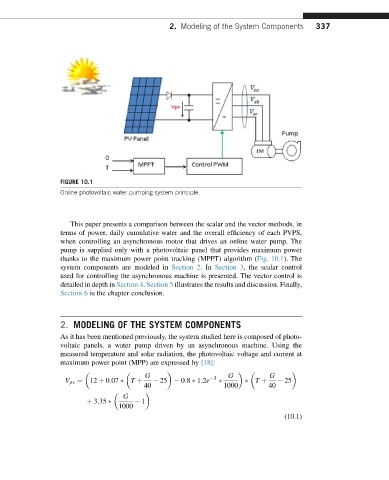
                  FIGURE 10.1
                  Online photovoltaic water pumping system principle.


                     This paper presents a comparison between the scalar and the vector methods, in
                  terms of power, daily cumulative water and the overall efficiency of each PVPS,
                  when controlling an asynchronous motor that drives an online water pump. The
                  pump is supplied only with a photovoltaic panel that provides maximum power
                  thanks to the maximum power point tracking (MPPT) algorithm (Fig. 10.1). The
                  system components are modeled in Section 2.In Section 3, the scalar control
                  used for controlling the asynchronous machine is presented. The vector control is
                  detailed in depth in Section 4. Section 5 illustrates the results and discussion. Finally,
                  Section 6 is the chapter conclusion.


                  2. MODELING OF THE SYSTEM COMPONENTS
                  As it has been mentioned previously, the system studied here is composed of photo-
                  voltaic panels, a water pump driven by an asynchronous machine. Using the
                  measured temperature and solar radiation, the photovoltaic voltage and current at
                  maximum power point (MPP) are expressed by [18]:

                                         G                  3   G           G
                   V pv ¼  12 þ 0:07   T þ    25   0:8   1:2e          T þ      25
                                         40                    1000        40
                                   G

                         þ 3:35         1
                                  1000
                                                                                (10.1)

