


Page 368 - Advances in Renewable Energies and Power Technologies
P. 368
4. The Vector Control   341


                                          +            PI
                                           -


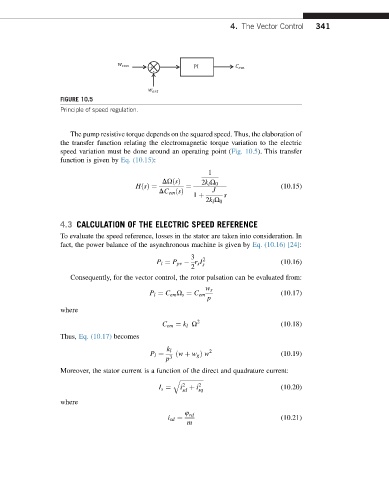
                  FIGURE 10.5
                  Principle of speed regulation.


                     The pump resistive torque depends on the squared speed. Thus, the elaboration of
                  the transfer function relating the electromagnetic torque variation to the electric
                  speed variation must be done around an operating point (Fig. 10.5). This transfer
                  function is given by Eq. (10.15):
                                                           1
                                              DUðsÞ      2k l U 0
                                       HðsÞ¼         ¼                         (10.15)
                                             DC em ðsÞ      J
                                                       1 þ     s
                                                          2k l U 0

                  4.3 CALCULATION OF THE ELECTRIC SPEED REFERENCE
                  To evaluate the speed reference, losses in the stator are taken into consideration. In
                  fact, the power balance of the asynchronous machine is given by Eq. (10.16) [24]:
                                                      3  2
                                            P l ¼ P pv   r s I s               (10.16)
                                                      2
                     Consequently, for the vector control, the rotor pulsation can be evaluated from:
                                                          w s
                                          P l ¼ C em U s ¼ C em                (10.17)
                                                          p
                  where

                                              C em ¼ k l U 2                   (10.18)
                  Thus, Eq. (10.17) becomes
                                               k l         2
                                           P l ¼  3  ðw þ w g Þ w              (10.19)
                                               p
                  Moreover, the stator current is a function of the direct and quadrature current:
                                                 q ffiffiffiffiffiffiffiffiffiffiffiffiffiffiffiffi
                                                    2
                                             I s ¼  i þ i 2                    (10.20)
                                                    sd  sq
                  where
                                                    4 rd
                                                i sd ¼                         (10.21)
                                                     m

