


Page 365 - Advances in Renewable Energies and Power Technologies
P. 365
338    CHAPTER 10 Scalar and Vector Control of Induction Motor


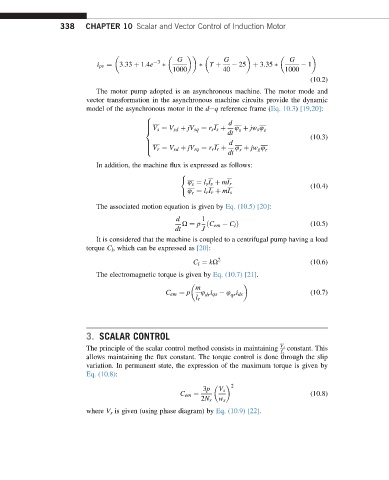
                                                  G            G                 G
                                             3
                            i pv ¼  3:33 þ 1:4e           T þ      25 þ 3:35          1
                                                 1000          40               1000
                                                                                       (10.2)
                            The motor pump adopted is an asynchronous machine. The motor mode and
                         vector transformation in the asynchronous machine circuits provide the dynamic
                         model of the asynchronous motor in the deq reference frame (Eq. 10.3) [19,20]:
                                         8
                                                                d
                                         >
                                         > V s ¼ V sd þ jV sq ¼ r s I s þ  4 þ jw s 4 s
                                         >
                                                                   s
                                                                dt
                                         <
                                                                                       (10.3)
                                                                d
                                         >
                                         >
                                         : V r ¼ V rd þ jV rq ¼ r r I r þ  4 þ jw g 4 r
                                         >
                                                                   r
                                                                dt
                            In addition, the machine flux is expressed as follows:
                                                   (
                                                     4 ¼ l s I s þ mI r                (10.4)
                                                      s
                                                      r
                                                     4 ¼ l r I r þ mI s
                            The associated motion equation is given by Eq. (10.5) [20]:
                                                  d      1
                                                   U ¼ p ðC em   C l Þ                 (10.5)
                                                  dt     J
                            It is considered that the machine is coupled to a centrifugal pump having a load
                         torque C l , which can be expressed as [20]:
                                                       C l ¼ kU 2                      (10.6)
                            The electromagnetic torque is given by Eq. (10.7) [21].

                                                       m
                                               C em ¼ p  4 i qs   4 i ds               (10.7)
                                                          dr
                                                                 qr
                                                       l r

                         3. SCALAR CONTROL
                         The principle of the scalar control method consists in maintaining  V s  constant. This
                                                                               f s
                         allows maintaining the flux constant. The torque control is done through the slip
                         variation. In permanent state, the expression of the maximum torque is given by
                         Eq. (10.8):

                                                                  2
                                                         3p   V s
                                                   C em ¼                              (10.8)
                                                         2N r w s
                         where V s is given (using phase diagram) by Eq. (10.9) [22].

