


Page 366 - Advances in Renewable Energies and Power Technologies
P. 366
4. The Vector Control   339


                                                                    Photovoltaic
                                                                      panel


                             +       PI              +  -             Inverter
                              -


                                                               p


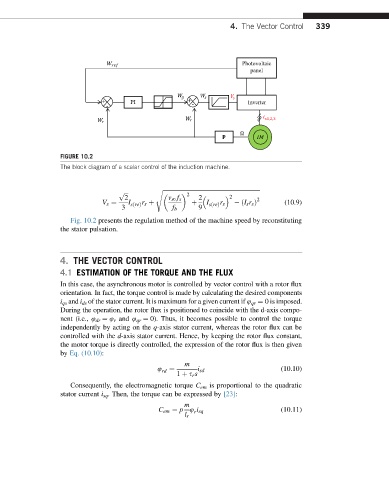
                  FIGURE 10.2
                  The block diagram of a scalar control of the induction machine.


                                  p         s ffiffiffiffiffiffiffiffiffiffiffiffiffiffiffiffiffiffiffiffiffiffiffiffiffiffiffiffiffiffiffiffiffiffiffiffiffiffiffiffiffiffiffiffiffiffiffiffiffiffiffiffiffiffiffiffiffiffiffiffiffiffiffiffiffi
                                    ffiffiffi
                                                     2
                                    2           v s0 f s  2      2      2
                                                              r
                                        r
                             V s ¼   I sðreÞ s þ      þ   I sðreÞ s   ðI s r s Þ  (10.9)
                                   3             f b    9
                     Fig. 10.2 presents the regulation method of the machine speed by reconstituting
                  the stator pulsation.
                  4. THE VECTOR CONTROL
                  4.1 ESTIMATION OF THE TORQUE AND THE FLUX

                  In this case, the asynchronous motor is controlled by vector control with a rotor flux
                  orientation. In fact, the torque control is made by calculating the desired components
                  i qs and i ds of the stator current. It is maximum for a given current if 4 qr ¼ 0is imposed.
                  During the operation, the rotor flux is positioned to coincide with the d-axis compo-
                  nent (i.e., 4 dr ¼ 4 r and 4 qr ¼ 0). Thus, it becomes possible to control the torque
                  independently by acting on the q-axis stator current, whereas the rotor flux can be
                  controlled with the d-axis stator current. Hence, by keeping the rotor flux constant,
                  the motor torque is directly controlled, the expression of the rotor flux is then given
                  by Eq. (10.10):
                                                    m
                                             4 rd  ¼    i sd                   (10.10)
                                                  1 þ s r s
                     Consequently, the electromagnetic torque C em is proportional to the quadratic
                  stator current i sq . Then, the torque can be expressed by [23]:
                                                    m
                                             C em ¼ p 4 i sq                   (10.11)
                                                       r
                                                    l r

