


Page 369 - Advances in Renewable Energies and Power Technologies
P. 369
342    CHAPTER 10 Scalar and Vector Control of Induction Motor


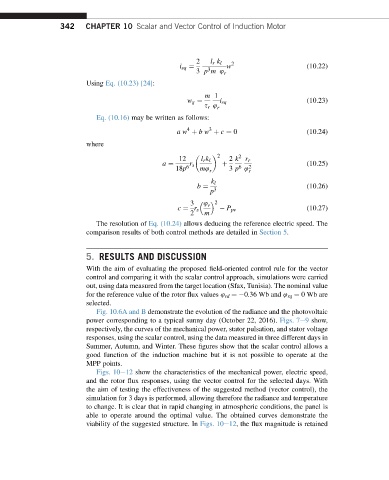
                                                       2   l r k l  2
                                                   i sq ¼       w                     (10.22)
                                                           3
                                                       3 p m 4
                                                               r
                         Using Eq. (10.23) [24]:
                                                          m 1
                                                     w g ¼    i sq                    (10.23)
                                                          s r 4 r
                            Eq. (10.16) may be written as follows:
                                                     4     3
                                                  aw þ bw þ c ¼ 0                     (10.24)
                         where

                                                             2     2

                                                   12    l r k l  2 k r r

                                              a ¼    r s       þ                      (10.25)
                                                                   6
                                                  18p 6  m4      3 p 4 2
                                                           r          r
                                                           k l
                                                        b ¼                           (10.26)
                                                           p 3
                                                      3      2
                                                         4
                                                           r
                                                  c ¼ r s       P pv                  (10.27)
                                                      2   m
                            The resolution of Eq. (10.24) allows deducing the reference electric speed. The
                         comparison results of both control methods are detailed in Section 5.
                         5. RESULTS AND DISCUSSION
                         With the aim of evaluating the proposed field-oriented control rule for the vector
                         control and comparing it with the scalar control approach, simulations were carried
                         out, using data measured from the target location (Sfax, Tunisia). The nominal value
                         for the reference value of the rotor flux values 4 rd ¼ 0.36 Wb and 4 rq ¼ 0 Wb are
                         selected.
                            Fig. 10.6A and B demonstrate the evolution of the radiance and the photovoltaic
                         power corresponding to a typical sunny day (October 22, 2016). Figs. 7e9 show,
                         respectively, the curves of the mechanical power, stator pulsation, and stator voltage
                         responses, using the scalar control, using the data measured in three different days in
                         Summer, Autumn, and Winter. These figures show that the scalar control allows a
                         good function of the induction machine but it is not possible to operate at the
                         MPP points.
                            Figs. 10e12 show the characteristics of the mechanical power, electric speed,
                         and the rotor flux responses, using the vector control for the selected days. With
                         the aim of testing the effectiveness of the suggested method (vector control), the
                         simulation for 3 days is performed, allowing therefore the radiance and temperature
                         to change. It is clear that in rapid changing in atmospheric conditions, the panel is
                         able to operate around the optimal value. The obtained curves demonstrate the
                         viability of the suggested structure. In Figs. 10e12, the flux magnitude is retained

