


Page 378 - Advances in Renewable Energies and Power Technologies
P. 378
2. Photovoltaic Principle, Cells Technologies, and Efficiencies  351


                  2. PHOTOVOLTAIC PRINCIPLE, CELLS TECHNOLOGIES, AND
                     EFFICIENCIES
                  2.1 PHOTOVOLTAIC PRINCIPLE

                  The photovoltaic cells use the photoelectric effect to produce direct current by ab-
                  sorption of solar radiation. This effect allows the cells to directly convert the light
                  energy of the photons into electricity by using a semiconductor material carrying
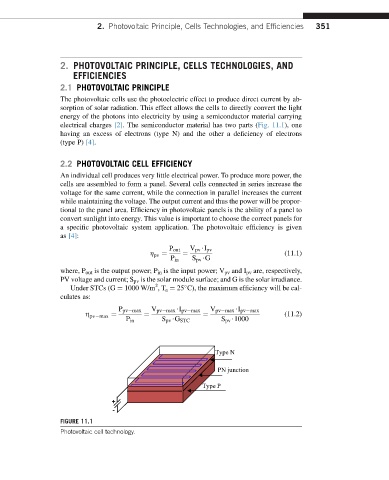
                  electrical charges [2]. The semiconductor material has two parts (Fig. 11.1), one
                  having an excess of electrons (type N) and the other a deficiency of electrons
                  (type P) [4].


                  2.2 PHOTOVOLTAIC CELL EFFICIENCY
                  An individual cell produces very little electrical power. To produce more power, the
                  cells are assembled to form a panel. Several cells connected in series increase the
                  voltage for the same current, while the connection in parallel increases the current
                  while maintaining the voltage. The output current and thus the power will be propor-
                  tional to the panel area. Efficiency in photovoltaic panels is the ability of a panel to
                  convert sunlight into energy. This value is important to choose the correct panels for
                  a specific photovoltaic system application. The photovoltaic efficiency is given
                  as [4]:

                                                P out  V pv $I pv
                                           h pv  ¼  ¼                           (11.1)
                                                P in  S pv $G
                  where, P out is the output power; P in is the input power; V pv and I pv are, respectively,
                  PV voltage and current; S pv is the solar module surface; and G is the solar irradiance.
                                            2
                     Under STCs (G ¼ 1000 W/m ,T a ¼ 25 C), the maximum efficiency will be cal-

                  culates as:
                                  P pv max  V pv max $I pv max  V pv max $I pv max
                         h pv max  ¼     ¼               ¼                      (11.2)
                                    P in      S pv $G STC     S pv $1000


                                                             Type N

                                                             PN junction
                                                         Type P

                                +
                                -
                  FIGURE 11.1
                  Photovoltaic cell technology.

