


Page 156 - Air Pollution Control Engineering
P. 156
03_chap_wang.qxd  05/05/2004  12:48 pm  Page 135
                    Cyclones                                                                  135

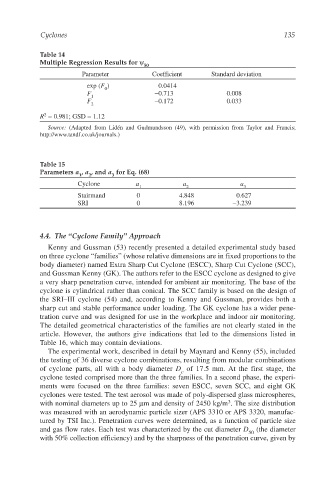
                    Table 14
                    Multiple Regression Results for ψ
                                                   50
                                 Parameter            Coefficient       Standard deviation
                                  exp (F )              0.0414
                                        0
                                  F                    −0.713               0.008
                                    1
                                  F                    −0.172               0.033
                                    2
                     2
                    R = 0.981; GSD = 1.12
                       Source: (Adapted from Lidén and Gudmundsson (49), with permission from  Taylor and Francis;
                    http://www.tandf.co.uk/journals.)


                    Table 15
                    Parameters a , a , and a for Eq. (68)
                                1  2      3
                                Cyclone          a             a                a
                                                  1             2                3
                                Stairmand        0            4.848            0.627
                                SRI              0            8.196           −3.239


                    4.4. The “Cyclone Family” Approach
                       Kenny and Gussman (53) recently presented a detailed experimental study based
                    on three cyclone “families” (whose relative dimensions are in fixed proportions to the
                    body diameter) named Extra Sharp Cut Cyclone (ESCC), Sharp Cut Cyclone (SCC),
                    and Gussman Kenny (GK). The authors refer to the ESCC cyclone as designed to give
                    a very sharp penetration curve, intended for ambient air monitoring. The base of the
                    cyclone is cylindrical rather than conical. The SCC family is based on the design of
                    the SRI–III cyclone (54) and, according to Kenny and Gussman, provides both a
                    sharp cut and stable performance under loading. The GK cyclone has a wider pene-
                    tration curve and was designed for use in the workplace and indoor air monitoring.
                    The detailed geometrical characteristics of the families are not clearly stated in the
                    article. However, the authors give indications that led to the dimensions listed in
                    Table 16, which may contain deviations.
                       The experimental work, described in detail by Maynard and Kenny (55), included
                    the testing of 36 diverse cyclone combinations, resulting from modular combinations
                    of cyclone parts, all with a body diameter  D of 17.5 mm. At the first stage, the
                                                               c
                    cyclone tested comprised more than the three families. In a second phase, the experi-
                    ments were focused on the three families: seven ESCC, seven SCC, and eight GK
                    cyclones were tested. The test aerosol was made of poly-dispersed glass microspheres,
                                                                             3
                    with nominal diameters up to 25 µm and density of 2450 kg/m . The size distribution
                    was measured with an aerodynamic particle sizer (APS 3310 or APS 3320, manufac-
                    tured by TSI Inc.). Penetration curves were determined, as a function of particle size
                    and gas flow rates. Each test was characterized by the cut diameter D  (the diameter
                                                                                   50
                    with 50% collection efficiency) and by the sharpness of the penetration curve, given by

