


Page 105 - Air and gas Drilling Field Guide 3rd Edition
P. 105
96    CHAPTER 5 Compressors and Nitrogen Generators


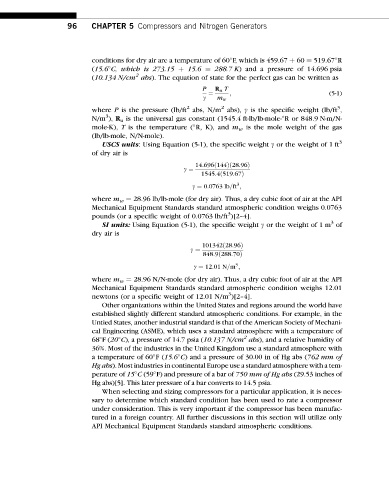
                          conditions for dry air are a temperature of 60 F, which is 459.67 þ 60 ¼ 519.67 R
                          (15.6 C, which is 273.15 þ 15.6 ¼ 288.7 K) and a pressure of 14.696 psia

                                       2
                          (10.134 N/cm abs). The equation of state for the perfect gas can be written as
                                                         P   R u T
                                                           ¼     ;                          (5-1)
                                                             m w
                                                         g
                                                     2        2                               3
                          where P is the pressure (lb/ft abs, N/m abs), g is the specific weight (lb/ft ,
                              3

                          N/m ), R u is the universal gas constant (1545.4 ft-lb/lb-mole- R or 848.9 N-m/N-

                          mole-K), T is the temperature ( R, K), and m w is the mole weight of the gas
                          (lb/lb-mole, N/N-mole).
                             USCS units: Using Equation (5-1), the specific weight g or the weight of 1 ft 3
                          of dry air is
                                                       14:696ð144Þð28:96Þ
                                                    g ¼
                                                         1545:4ð519:67Þ
                                                                   3
                                                      g ¼ 0:0763 lb=ft ;
                          where m w ¼ 28.96 lb/lb-mole (for dry air). Thus, a dry cubic foot of air at the API
                          Mechanical Equipment Standards standard atmospheric condition weighs 0.0763
                                                                3
                          pounds (or a specific weight of 0.0763 lb/ft )[2–4].
                                                                                             3
                             SI units: Using Equation (5-1), the specific weight g or the weight of 1 m of
                          dry air is
                                                         101342ð28:96Þ
                                                      g ¼
                                                         848:9ð288:70Þ
                                                                  3
                                                       g ¼ 12:01 N=m ;
                          where m w ¼ 28.96 N/N-mole (for dry air). Thus, a dry cubic foot of air at the API
                          Mechanical Equipment Standards standard atmospheric condition weighs 12.01
                                                                3
                          newtons (or a specific weight of 12.01 N/m )[2–4].
                             Other organizations within the United States and regions around the world have
                          established slightly different standard atmospheric conditions. For example, in the
                          Untied States, another industrial standard is that of the American Society of Mechani-
                          cal Engineering (ASME), which uses a standard atmosphere with a temperature of
                                                                     2


                          68 F(20 C), a pressure of 14.7 psia (10.137 N/cm abs), and a relative humidity of
                          36%. Most of the industries in the United Kingdom use a standard atmosphere with

                          a temperature of 60 F(15.6 C) and a pressure of 30.00 in of Hg abs (762 mm of

                          Hgabs). Most industries in continental Europe use a standard atmosphere with a tem-
                          perature of 15 C (59 F) and pressure of a bar of 750 mm of Hg abs (29.53 inches of


                          Hg abs)[5]. This later pressure of a bar converts to 14.5 psia.
                             When selecting and sizing compressors for a particular application, it is neces-
                          sary to determine which standard condition has been used to rate a compressor
                          under consideration. This is very important if the compressor has been manufac-
                          tured in a foreign country. All further discussions in this section will utilize only
                          API Mechanical Equipment Standards standard atmospheric conditions.

