


Page 108 - Air and gas Drilling Field Guide 3rd Edition
P. 108
5.3 Continuous Flow (Dynamic) Compressors      99


              rather low, of the order of 2, there is little need for intercooling between each stage
              (Figure 5-5 shows an intercooler after first three stages).
                 The centrifugal compressor must operate at rather high rotation speeds to be
              efficient. Most commercial centrifugal compressors operate at speeds on the
              order of 20,000 to 30,000 rpm. With such rotation speeds, very large volumes
              of gas can be compressed with equipment having rather modest external dimen-
              sions. Commercial centrifugal compressors can operate with volumetric flow
                                       4                   3
              rates up to approximately 10 actual cfm (4.7   10 actual liters/sec) and with
              overall multistage compression ratios up to about 20.
                 Centrifugal compressors are usually used in large processing plants and in
              some pipeline applications. They can be operated with some small percentage
              of liquid in the gas flow.
                 These machines are used principally to compress large volumetric flow rates
              to rather modest pressures. Thus, their use is more applicable to the petroleum
              refining and chemical processing industries.
                 More details regarding the centrifugal compressor can be found elsewhere
              [2, 7–9].


              5.3.2 Axial-Flow Compressors
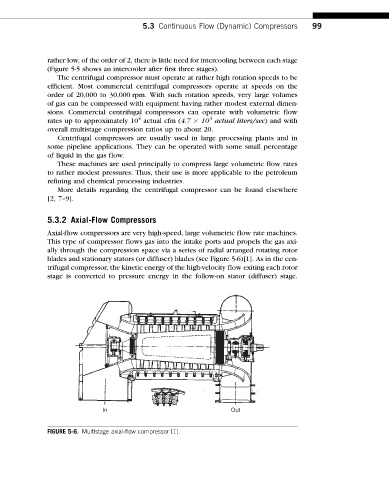
              Axial-flow compressors are very high-speed, large volumetric flow rate machines.
              This type of compressor flows gas into the intake ports and propels the gas axi-
              ally through the compression space via a series of radial arranged rotating rotor
              blades and stationary stators (or diffuser) blades (see Figure 5-6)[1]. As in the cen-
              trifugal compressor, the kinetic energy of the high-velocity flow exiting each rotor
              stage is converted to pressure energy in the follow-on stator (diffuser) stage.


                             In                                  Out

              FIGURE 5-6. Multistage axial-flow compressor [1].

