


Page 110 - Air and gas Drilling Field Guide 3rd Edition
P. 110
5.4 Intermittent (Positive Displacement) Compressors   101


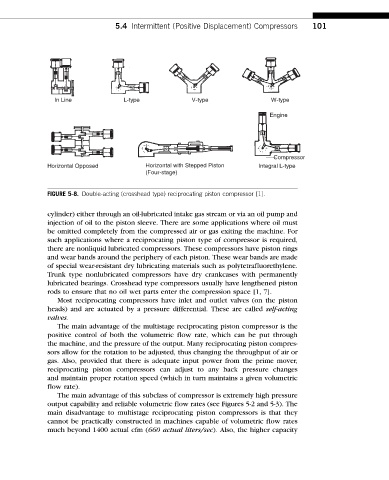
                In Line            L-type             V-type                W-type

                                                                            Engine


                                                                             Compressor
              Horizontal Opposed         Horizontal with Stepped Piston  Integral L-type
                                         (Four-stage)

              FIGURE 5-8. Double-acting (crosshead type) reciprocating piston compressor [1].


              cylinder) either through an oil-lubricated intake gas stream or via an oil pump and
              injection of oil to the piston sleeve. There are some applications where oil must
              be omitted completely from the compressed air or gas exiting the machine. For
              such applications where a reciprocating piston type of compressor is required,
              there are nonliquid lubricated compressors. These compressors have piston rings
              and wear bands around the periphery of each piston. These wear bands are made
              of special wear-resistant dry lubricating materials such as polytetrafluorethylene.
              Trunk type nonlubricated compressors have dry crankcases with permanently
              lubricated bearings. Crosshead type compressors usually have lengthened piston
              rods to ensure that no oil wet parts enter the compression space [1, 7].
                 Most reciprocating compressors have inlet and outlet valves (on the piston
              heads) and are actuated by a pressure differential. These are called self-acting
              valves.
                 The main advantage of the multistage reciprocating piston compressor is the
              positive control of both the volumetric flow rate, which can be put through
              the machine, and the pressure of the output. Many reciprocating piston compres-
              sors allow for the rotation to be adjusted, thus changing the throughput of air or
              gas. Also, provided that there is adequate input power from the prime mover,
              reciprocating piston compressors can adjust to any back pressure changes
              and maintain proper rotation speed (which in turn maintains a given volumetric
              flow rate).
                 The main advantage of this subclass of compressor is extremely high pressure
              output capability and reliable volumetric flow rates (see Figures 5-2 and 5-3). The
              main disadvantage to multistage reciprocating piston compressors is that they
              cannot be practically constructed in machines capable of volumetric flow rates
              much beyond 1400 actual cfm (660 actual liters/sec). Also, the higher capacity

