


Page 109 - Air and gas Drilling Field Guide 3rd Edition
P. 109
100     CHAPTER 5 Compressors and Nitrogen Generators


                                                                                             4
                          Axial-flow compressors have a volumetric flow rate range of approximately 10 to
                             6
                                                      5
                          10 actual cfm (4.7 to 4.7   10 actual liters/sec). Their compression ratios are
                          typically around 10 to 20. Because of their small diameter, these machines are
                          the principal compressor design for jet engine applications. There are also appli-
                          cations for axial-flow compressors in large process plant operations where very
                          large constant volumetric flow rates at low compression ratios are needed.
                             More detail regarding axial-flow compressors can be found elsewhere [2, 7–9].


                          5.4 INTERMITTENT (POSITIVE DISPLACEMENT)
                          COMPRESSORS
                          In general, only the reciprocating compressor allows for rather complete reliable
                          flexibility in applications requiring variable volumetric flow rates and variable
                          pressure ratios. The rotary compressor (which has a fixed pressure ratio built into
                          the compressor design) does not allow for much variation in either.


                          5.4.1 Reciprocating Compressors
                          The reciprocating compressor is the simplest example of the positive displace-
                          ment class of compressors. This type of compressor was also the earliest
                          designed. Like reciprocating incompressible fluid pumps, reciprocating compres-
                          sors can also be either single acting or double acting. Single-acting compressors
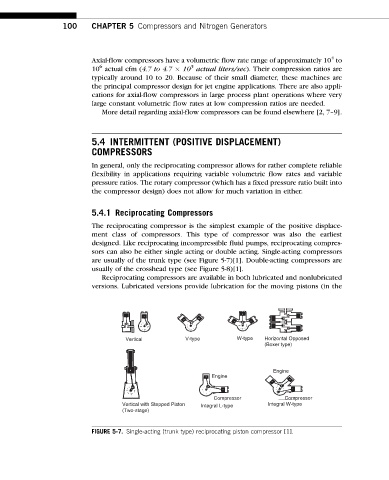
                          are usually of the trunk type (see Figure 5-7)[1]. Double-acting compressors are
                          usually of the crosshead type (see Figure 5-8)[1].
                             Reciprocating compressors are available in both lubricated and nonlubricated
                          versions. Lubricated versions provide lubrication for the moving pistons (in the


                                    Vertical        V-type         W-type  Horizontal Opposed
                                                                          (Boxer type)


                                                                             Engine
                                                            Engine


                                                            Compressor          Compressor
                                   Vertical with Stepped Piston  Integral L-type  Integral W-type
                                   (Two-stage)

                          FIGURE 5-7. Single-acting (trunk type) reciprocating piston compressor [1].

