


Page 574 -
P. 574
554   CHAPTER 13 DECISION ANALYSIS


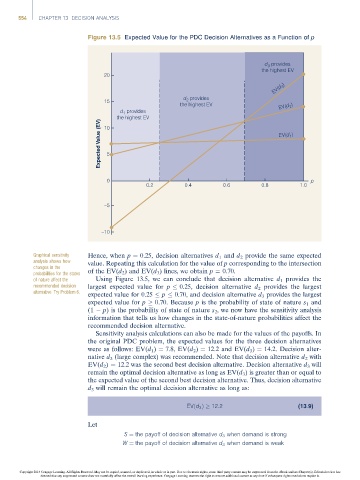
                                     Figure 13.5 Expected Value for the PDC Decision Alternatives as a Function of p


                                                                                           d 3  provides
                                                                                          the highest EV
                                          20
                                                                                              EV(d 3 )

                                                                  d  provides
                                          15                       2
                                                                 the highest EV                EV(d 2 )
                                              d 1  provides
                                             the highest EV
                                        Expected Value (EV)  5                                 EV(d 1 )
                                          10


                                          0                                                              p
                                                      0.2         0.4         0.6         0.8         1.0


                                          –5


                                         –10


                    Graphical sensitivity  Hence, when p ¼ 0.25, decision alternatives d 1 and d 2 provide the same expected
                    analysis shows how  value. Repeating this calculation for the value of p corresponding to the intersection
                    changes in the
                    probabilities for the states  of the EV(d 2 ) and EV(d 3 ) lines, we obtain p ¼ 0.70.
                    of nature affect the  Using Figure 13.5, we can conclude that decision alternative d 1 provides the
                    recommended decision  largest expected value for p   0.25, decision alternative d 2 provides the largest
                    alternative. Try Problem 6.
                                     expected value for 0.25   p   0.70, and decision alternative d 3 provides the largest
                                     expected value for p   0.70. Because p is the probability of state of nature s 1 and
                                     (1   p) is the probability of state of nature s 2 , we now have the sensitivity analysis
                                     information that tells us how changes in the state-of-nature probabilities affect the
                                     recommended decision alternative.
                                       Sensitivity analysis calculations can also be made for the values of the payoffs. In
                                     the original PDC problem, the expected values for the three decision alternatives
                                     were as follows: EV(d 1 ) ¼ 7.8, EV(d 2 ) ¼ 12.2 and EV(d 3 ) ¼ 14.2. Decision alter-
                                     native d 3 (large complex) was recommended. Note that decision alternative d 2 with
                                     EV(d 2 ) ¼ 12.2 was the second best decision alternative. Decision alternative d 3 will
                                     remain the optimal decision alternative as long as EV(d 3 ) is greater than or equal to
                                     the expected value of the second best decision alternative. Thus, decision alternative
                                     d 3 will remain the optimal decision alternative as long as:


                                                                   EVðd 3 Þ  12:2                    (13:9)

                                     Let
                                                S ¼ the payoff of decision alternative d 3 when demand is strong
                                               W ¼ the payoff of decision alternative d 3 when demand is weak


                Copyright 2014 Cengage Learning. All Rights Reserved. May not be copied, scanned, or duplicated, in whole or in part. Due to electronic rights, some third party content may be suppressed from the eBook and/or eChapter(s). Editorial review has
                      deemed that any suppressed content does not materially affect the overall learning experience. Cengage Learning reserves the right to remove additional content at any time if subsequent rights restrictions require it.

