


Page 572 -
P. 572
552   CHAPTER 13 DECISION ANALYSIS


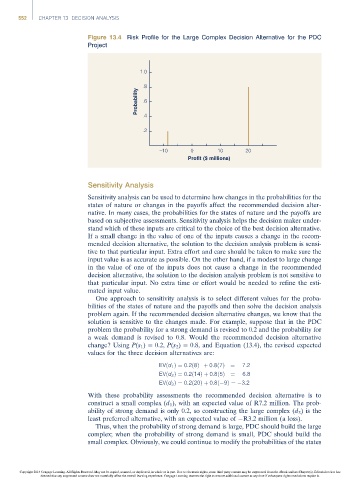
                                     Figure 13.4 Risk Profile for the Large Complex Decision Alternative for the PDC
                                     Project


                                                     1.0

                                                     .8
                                                    Probability  .6


                                                     .4

                                                     .2


                                                           –10      0       10       20
                                                                   Profit ($ millions)


                                     Sensitivity Analysis

                                     Sensitivity analysis can be used to determine how changes in the probabilities for the
                                     states of nature or changes in the payoffs affect the recommended decision alter-
                                     native. In many cases, the probabilities for the states of nature and the payoffs are
                                     based on subjective assessments. Sensitivity analysis helps the decision maker under-
                                     stand which of these inputs are critical to the choice of the best decision alternative.
                                     If a small change in the value of one of the inputs causes a change in the recom-
                                     mended decision alternative, the solution to the decision analysis problem is sensi-
                                     tive to that particular input. Extra effort and care should be taken to make sure the
                                     input value is as accurate as possible. On the other hand, if a modest to large change
                                     in the value of one of the inputs does not cause a change in the recommended
                                     decision alternative, the solution to the decision analysis problem is not sensitive to
                                     that particular input. No extra time or effort would be needed to refine the esti-
                                     mated input value.
                                       One approach to sensitivity analysis is to select different values for the proba-
                                     bilities of the states of nature and the payoffs and then solve the decision analysis
                                     problem again. If the recommended decision alternative changes, we know that the
                                     solution is sensitive to the changes made. For example, suppose that in the PDC
                                     problem the probability for a strong demand is revised to 0.2 and the probability for
                                     a weak demand is revised to 0.8. Would the recommended decision alternative
                                     change? Using P(s 1 ) ¼ 0.2, P(s 2 ) ¼ 0.8, and Equation (13.4), the revised expected
                                     values for the three decision alternatives are:
                                                          EVðd 1 Þ¼ 0:2ð8Þþ 0:8ð7Þ¼  7:2
                                                          EVðd 2 Þ¼ 0:2ð14Þþ 0:8ð5Þ¼  6:8
                                                          EVðd 3 Þ¼ 0:2ð20Þþ 0:8ð 9Þ¼ 3:2

                                     With these probability assessments the recommended decision alternative is to
                                     construct a small complex (d 1 ), with an expected value of R7.2 million. The prob-
                                     ability of strong demand is only 0.2, so constructing the large complex (d 3 ) is the
                                     least preferred alternative, with an expected value of  R3.2 million (a loss).
                                       Thus, when the probability of strong demand is large, PDC should build the large
                                     complex; when the probability of strong demand is small, PDC should build the
                                     small complex. Obviously, we could continue to modify the probabilities of the states


                Copyright 2014 Cengage Learning. All Rights Reserved. May not be copied, scanned, or duplicated, in whole or in part. Due to electronic rights, some third party content may be suppressed from the eBook and/or eChapter(s). Editorial review has
                      deemed that any suppressed content does not materially affect the overall learning experience. Cengage Learning reserves the right to remove additional content at any time if subsequent rights restrictions require it.

