


Page 569 -
P. 569
DECISION MAKING WITH PROBABILITIES  549


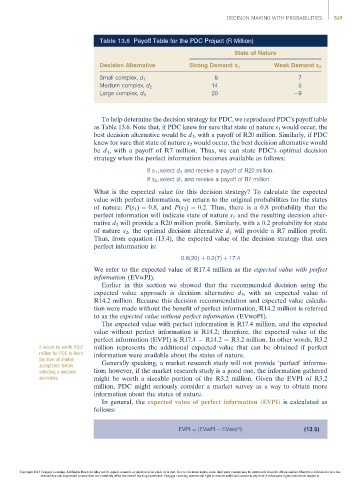
                                        Table 13.6 Payoff Table for the PDC Project (R Million)
                                                                                  State of Nature
                                        Decision Alternative        Strong Demand s 1         Weak Demand s 2

                                                                           8                         7
                                        Small complex, d 1
                                                                           14                        5
                                        Medium complex, d 2
                                                                           20                        9
                                        Large complex, d 3

                                         To help determine the decision strategy for PDC, we reproduced PDC’s payoff table
                                      as Table 13.6. Note that, if PDC knew for sure that state of nature s 1 would occur, the
                                      best decision alternative would be d 3 , with a payoff of R20 million. Similarly, if PDC
                                      knew for sure that state of nature s 2 would occur, the best decision alternative would
                                      be d 1 , with a payoff of R7 million. Thus, we can state PDC’s optimal decision
                                      strategy when the perfect information becomes available as follows:

                                                       If s 1 ; select d 3 and receive a payoff of R20 million:
                                                       If s 2 ; select d 1 and receive a payoff of R7 million:

                                      What is the expected value for this decision strategy? To calculate the expected
                                      value with perfect information, we return to the original probabilities for the states
                                      of nature: P(s 1 ) ¼ 0.8, and P(s 2 ) ¼ 0.2. Thus, there is a 0.8 probability that the
                                      perfect information will indicate state of nature s 1 and the resulting decision alter-
                                      native d 3 will provide a R20 million profit. Similarly, with a 0.2 probability for state
                                      of nature s 2 , the optimal decision alternative d 1 will provide a R7 million profit.
                                      Thus, from equation (13.4), the expected value of the decision strategy that uses
                                      perfect information is:
                                                                 0:8ð20Þþ 0:2ð7Þþ 17:4

                                      We refer to the expected value of R17.4 million as the expected value with perfect
                                      information (EVwPI).
                                         Earlier in this section we showed that the recommended decision using the
                                      expected value approach is decision alternative d 3 , with an expected value of
                                      R14.2 million. Because this decision recommendation and expected value calcula-
                                      tion were made without the benefit of perfect information, R14.2 million is referred
                                      to as the expected value without perfect information (EVwoPI).
                                         The expected value with perfect information is R17.4 million, and the expected
                                      value without perfect information is R14.2; therefore, the expected value of the
                                      perfect information (EVPI) is R17.4   R14.2 ¼ R3.2 million. In other words, R3.2
                      It would be worth R3.2  million represents the additional expected value that can be obtained if perfect
                      million for PDC to learn  information were available about the states of nature.
                      the level of market
                      acceptance before  Generally speaking, a market research study will not provide ‘perfect’ informa-
                      selecting a decision  tion; however, if the market research study is a good one, the information gathered
                      alternative.    might be worth a sizeable portion of the R3.2 million. Given the EVPI of R3.2
                                      million, PDC might seriously consider a market survey as a way to obtain more
                                      information about the states of nature.
                                         In general, the expected value of perfect information (EVPI) is calculated as
                                      follows:

                                                                EVPI ¼jEVwPI   EVwoPIj                 (13:5)


                Copyright 2014 Cengage Learning. All Rights Reserved. May not be copied, scanned, or duplicated, in whole or in part. Due to electronic rights, some third party content may be suppressed from the eBook and/or eChapter(s). Editorial review has
                      deemed that any suppressed content does not materially affect the overall learning experience. Cengage Learning reserves the right to remove additional content at any time if subsequent rights restrictions require it.

