


Page 571 -
P. 571
RISK ANALYSIS AND SENSITIVITY ANALYSIS  551


                        NOTES AND COMMENTS


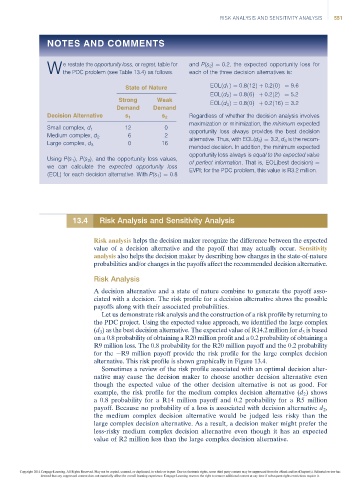
                             e restate the opportunity loss,or regret, table for  and P(s 2 ) ¼ 0.2, the expected opportunity loss for
                        W the PDC problem (see Table 13.4) as follows.  each of the three decision alternatives is:
                                                                          EOLðd 1 Þ¼ 0:8ð12Þþ 0:2ð0Þ¼ 9:6
                                                State of Nature
                                                                          EOLðd 2 Þ¼ 0:8ð6Þþ 0:2ð2Þ¼ 5:2
                                              Strong      Weak
                                                                          EOLðd 3 Þ¼ 0:8ð0Þþ 0:2ð16Þ¼ 3:2
                                             Demand      Demand
                        Decision Alternative    s 1        s 2      Regardless of whether the decision analysis involves
                                                                    maximization or minimization, the minimum expected
                                                12          0
                        Small complex, d 1
                                                                    opportunity loss always provides the best decision
                                                 6          2
                        Medium complex, d 2
                                                                    alternative. Thus, with EOL(d 3 ) ¼ 3.2, d 3 is the recom-
                                                 0         16
                        Large complex, d 3
                                                                    mended decision. In addition, the minimum expected
                                                                    opportunity loss always is equal to the expected value
                        Using P(s 1 ), P(s 2 ), and the opportunity loss values,
                                                                    of perfect information. That is, EOL(best decision) ¼
                        we can calculate the expected opportunity loss
                                                                    EVPI; for the PDC problem, this value is R3.2 million.
                        (EOL) for each decision alternative. With P(s 1 ) ¼ 0.8

                                13.4    Risk Analysis and Sensitivity Analysis


                                      Risk analysis helps the decision maker recognize the difference between the expected
                                      value of a decision alternative and the payoff that may actually occur. Sensitivity
                                      analysis also helps the decision maker by describing how changes in the state-of-nature
                                      probabilities and/or changes in the payoffs affect the recommended decision alternative.
                                      Risk Analysis

                                      A decision alternative and a state of nature combine to generate the payoff asso-
                                      ciated with a decision. The risk profile for a decision alternative shows the possible
                                      payoffs along with their associated probabilities.
                                         Let us demonstrate risk analysis and the construction of a risk profile by returning to
                                      the PDC project. Using the expected value approach, we identified the large complex
                                      (d 3 ) as the best decision alternative. The expected value of R14.2 million for d 3 is based
                                      on a 0.8 probability of obtaining a R20 million profit and a 0.2 probability of obtaining a
                                      R9 million loss. The 0.8 probability for the R20 million payoff and the 0.2 probability
                                      for the  R9 million payoff provide the risk profile for the large complex decision
                                      alternative. This risk profile is shown graphically in Figure 13.4.
                                         Sometimes a review of the risk profile associated with an optimal decision alter-
                                      native may cause the decision maker to choose another decision alternative even
                                      though the expected value of the other decision alternative is not as good. For
                                      example, the risk profile for the medium complex decision alternative (d 2 ) shows
                                      a 0.8 probability for a R14 million payoff and 0.2 probability for a R5 million
                                      payoff. Because no probability of a loss is associated with decision alternative d 2 ,
                                      the medium complex decision alternative would be judged less risky than the
                                      large complex decision alternative. As a result, a decision maker might prefer the
                                      less-risky medium complex decision alternative even though it has an expected
                                      value of R2 million less than the large complex decision alternative.


                Copyright 2014 Cengage Learning. All Rights Reserved. May not be copied, scanned, or duplicated, in whole or in part. Due to electronic rights, some third party content may be suppressed from the eBook and/or eChapter(s). Editorial review has
                      deemed that any suppressed content does not materially affect the overall learning experience. Cengage Learning reserves the right to remove additional content at any time if subsequent rights restrictions require it.

