


Page 568 -
P. 568
548   CHAPTER 13 DECISION ANALYSIS


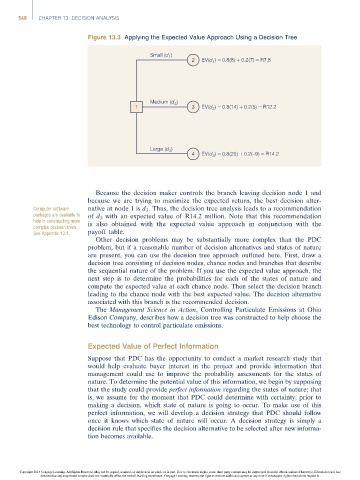
                                     Figure 13.3 Applying the Expected Value Approach Using a Decision Tree

                                                        Small (d 1 )
                                                                    2   EV(d ) = 0.8(8) + 0.2(7) = R7.8
                                                                           1


                                                        Medium (d )
                                                               2
                                                   1                3   EV(d ) = 0.8(14) + 0.2(5) = R12.2
                                                                           2


                                                        Large (d )
                                                             3
                                                                    4   EV(d 3 ) = 0.8(20) + 0.2(–9) = R14.2


                                       Because the decision maker controls the branch leaving decision node 1 and
                                     because we are trying to maximize the expected return, the best decision alter-
                    Computer software  native at node 1 is d 3 . Thus, the decision tree analysis leads to a recommendation
                    packages are available to  of d 3 with an expected value of R14.2 million. Note that this recommendation
                    help in constructing more
                    complex decision trees.  is also obtained with the expected value approach in conjunction with the
                    See Appendix 13.1.  payoff table.
                                       Other decision problems may be substantially more complex than the PDC
                                     problem, but if a reasonable number of decision alternatives and states of nature
                                     are present, you can use the decision tree approach outlined here. First, draw a
                                     decision tree consisting of decision nodes, chance nodes and branches that describe
                                     the sequential nature of the problem. If you use the expected value approach, the
                                     next step is to determine the probabilities for each of the states of nature and
                                     compute the expected value at each chance node. Then select the decision branch
                                     leading to the chance node with the best expected value. The decision alternative
                                     associated with this branch is the recommended decision.
                                       The Management Science in Action, Controlling Particulate Emissions at Ohio
                                     Edison Company, describes how a decision tree was constructed to help choose the
                                     best technology to control particulate emissions.


                                     Expected Value of Perfect Information

                                     Suppose that PDC has the opportunity to conduct a market research study that
                                     would help evaluate buyer interest in the project and provide information that
                                     management could use to improve the probability assessments for the states of
                                     nature. To determine the potential value of this information, we begin by supposing
                                     that the study could provide perfect information regarding the states of nature; that
                                     is, we assume for the moment that PDC could determine with certainty, prior to
                                     making a decision, which state of nature is going to occur. To make use of this
                                     perfect information, we will develop a decision strategy that PDC should follow
                                     once it knows which state of nature will occur. A decision strategy is simply a
                                     decision rule that specifies the decision alternative to be selected after new informa-
                                     tion becomes available.


                Copyright 2014 Cengage Learning. All Rights Reserved. May not be copied, scanned, or duplicated, in whole or in part. Due to electronic rights, some third party content may be suppressed from the eBook and/or eChapter(s). Editorial review has
                      deemed that any suppressed content does not materially affect the overall learning experience. Cengage Learning reserves the right to remove additional content at any time if subsequent rights restrictions require it.

