


Page 579 -
P. 579
DECISION ANALYSIS WITH SAMPLE INFORMATION 559
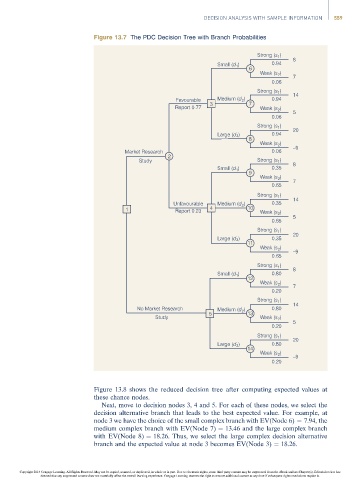
Figure 13.7 The PDC Decision Tree with Branch Probabilities
Strong (s ) 8
1
Small (d ) 0.94
1
6
Weak (s ) 7
2
0.06
Strong (s ) 14
1
Favourable Medium (d ) 0.94
2
Report 0.77 3 7 Weak (s )
2
0.06 5
Strong (s ) 20
1
Large (d 3) 0.94
8
Weak (s 2 ) –9
Market Research 0.06
2
Study Strong (s 1 ) 8
Small (d 1 ) 0.35
9
Weak (s 2 ) 7
0.65
Strong (s 1 ) 14
Unfavourable Medium (d ) 0.35
2
1 Report 0.23 4 10 Weak (s 2 )
5
0.65
Strong (s 1 )
20
Large (d 3) 0.35
11
Weak (s 2 ) –9
0.65
Strong (s ) 8
1
Small (d 1 ) 0.80
12
Weak (s 2 ) 7
0.20
Strong (s 1 ) 14
No Market Research Medium (d ) 0.80
2
5 13
Study Weak (s 2 )
5
0.20
Strong (s 1 ) 20
Large (d 3) 0.80
14
Weak (s ) –9
2
0.20
Figure 13.8 shows the reduced decision tree after computing expected values at
these chance nodes.
Next, move to decision nodes 3, 4 and 5. For each of these nodes, we select the
decision alternative branch that leads to the best expected value. For example, at
node 3 we have the choice of the small complex branch with EV(Node 6) ¼ 7.94, the
medium complex branch with EV(Node 7) ¼ 13.46 and the large complex branch
with EV(Node 8) ¼ 18.26. Thus, we select the large complex decision alternative
branch and the expected value at node 3 becomes EV(Node 3) ¼ 18.26.
Copyright 2014 Cengage Learning. All Rights Reserved. May not be copied, scanned, or duplicated, in whole or in part. Due to electronic rights, some third party content may be suppressed from the eBook and/or eChapter(s). Editorial review has
deemed that any suppressed content does not materially affect the overall learning experience. Cengage Learning reserves the right to remove additional content at any time if subsequent rights restrictions require it.

