


Page 382 - Analog and Digital Filter Design
P. 382
Digital FIR Filter Design  379


                       and 4 can be added before being multiplied by A2. The signals from the output
                       of  delay elements 1 and 5 can be added before being multiplied by Al. Finally,
                       the signals at the input and from the output of  delay element 6 can be  added
                       before being multiplied by AO. For the cost of three adders, multipliers  A4, AS,
                       and A6 can be removed.

                       If  the folded FIR filter is implemented in a digital signal processor (DSP), it
                       requires far less computational effort than the linear FIR filter. Summing cir-
                       cuits use little processor time, but multiplication requires a number of  shift and
                       add operations. Also, reading the filter coefficients from memory takes time. The
                       processor is only required to read half  the coefficients in a folded FIR filter.
                       In an FIR filter the delay to all signals is the same and does not depend upon
                       the signal frequency, therefore the group delay is constant. This is important for
                       filters handling impulsive signals because impulses contain a wide band of fre-
                       quencies; if the group delay is not constant, so that some frequencies are delayed
                       more than others, the impulse will have ringing superimposed on its waveform.
                       This is an undesirable distortion of the signal. On the other hand, basic speech
                       transmission is largely unaffected by group delay variations; for these applica-
                       tions IIR filters are more efficient.

                       The cutoff frequency (Fc) of  an FIR filter is directly proportional to the data-
                       sampling clock frequency. Using a single set of coeffkients, the cutoff frequency
                       can be doubled by doubling the sampling clock frequency. The normalized clock
                       frequency for a digital filter is 1 Hz or 27r rads
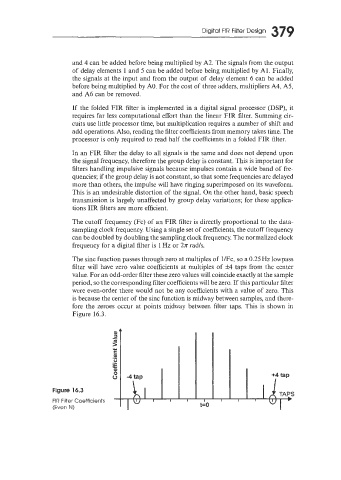
                       The sinc function passes through zero at multiples of  UFc, so a 0.25 Hz lowpass
                       filter will have zero value coefficients at multiples of  k4 taps from the center
                       value. For an odd-order filter these zero values will coincide exactly at the sample
                       period, so the corresponding filter coefficients will be zero. If this particular filter
                       were even-order there would not be any coefficients with a value of  zero. This
                       is because the center of the sinc function is midway between samples, and there-
                       fore the zeroes occur at points midway between filter taps. This is shown in
                       Figure 16.3.


                 Figure 16.3
                 FIR  Filter Coefficients
                 (Even  N)                                    t=O

